
Scholars frequently acknowledge the fundamental intertextuality of film music. When Claudia Gorbman examined the relationship between film, music, and semiotic codes—cinematic, cultural, and musically “pure”—she described ways that film scores generate meaning through their interconnectedness to one another and to noncinematic music (Gorbman 1987, 12–13). Generations of cinema composers have drawn on such codes, well-established intertextual traditions that comprise “musical conventions that harness musical affects to specific meanings through the power of association” (Kalinak 2010, 13). Kathryn Kalinak reminds us that these associations function effectively with or without explicit audience recognition:
Musical conventions become ingrained in a culture and function as a kind of musical collective unconscious, affecting listeners whether or not they are consciously aware of them. Think of musical conventions as a cultural shorthand that does not have to be consciously recognized by listeners to produce predictable responses. For obvious reasons, film composers depend on musical conventions to guide and control audience response. (Kalinak 2010, 13)
Thus, while film audiences might not know that brass instruments playing triadic themes carried heroic connotations on the nineteenth-century operatic stage, film composers certainly do, plunging their audiences into an intertextual field when they use romantic orchestral approaches. Such soundtracks, Anahid Kassabian writes, “assimilate” audiences into a well-established discursive web (Kassabian 2001, 3).
Film scores do not only draw on preexisting coded meanings; they also utilize preexisting music. Soundtracks involving music known to audiences—particularly those incorporating popular music—frequently employ a strategy that Kassabian calls “affiliating,” fracturing “the self-containedness of the diegetic world, making explicit the intertextual links with the viewers’ earlier experience” of the songs that they are hearing (Fiske [1987] 2011, 257). Robynn Stilwell has applied a geological metaphor to such intertextual encounters, calling analysis of preexisting film music “a kind of archaeology of the undertone […] that aims to work through the layers of connotations […] lying under concretions of time” (Powrie and Stilwell 2006, xix; see also Stilwell 1995). Similarly, Berthold Hoeckner and Jonathan Godsall have pointed out that as synchronized sound has passed its centenary, films continue to sonically emulate or even quote one another’s music, creating strata of interfilmic meanings that function as audiovisual “palimpsests” (Godsall 2014, 138; Hoeckner 2019, 93 ff.). Just as beneath any classical Hollywood film score may lurk uncited nineteenth-century sources, underneath the surface of any film of the post-classical era remain the traces of cinema’s past. To consider just one well-known example, Figure 1 and Musical Examples 1–2 highlight some of the most obvious visual and musical reminiscences of classical Hollywood film informing the Star Wars series; swashbuckling swordfights and narrative establishing title cards signal that George Lucas’s visual debts were no less significant than John Williams’s musical indebtedness to Erich Wolfgang Korngold for the basic melodic concept of his opening titles music. In short, both everyday cinematic experience and a wealth of scholarly work teach us that cinematic meanings come from reference points that lie outside the bounds of the opening and closing credits of any particular film.
Figure 1
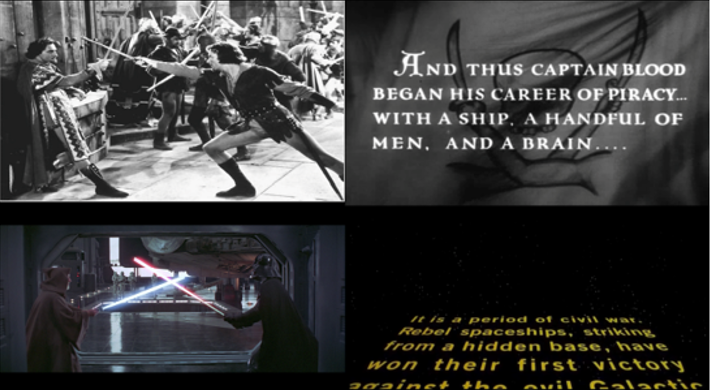
Visual intertextuality in Captain Blood (Michael Curtiz, 1935) and Star Wars (Georges Lucas, 1977).
© Warner Bros. / Lucasfilm; 20th Century Fox; Walt Disney Studios
Musical Example 1

Erich Wolfgang Korngold, Kings Row (Sam Wood, 1942), main theme.
Musical Example 2

John Williams, Star Wars, main theme.
Scholarship about film music thus relies on intertextuality as a fundamental aspect of its theory, and it has developed a robust vocabulary to describe films’ relationships to other arts and to one another. But existing studies have by no means exhausted the lexicon of intertextual literary theory, itself a jargon-happy field that continues to provide useful terms for describing common elements and approaches to film music and sound.1 In this paper, I draw on one theoretical concept from intertextual literary studies that has to date gone unnoticed by film music scholarship: Michael Riffaterre’s notion of “ungrammaticality.”
Despite the unfamiliarity of the disciplinary language, the core concept is a simple one: faced with something that one does not understand, that “makes no sense at all” within the grammatical boundaries established by any individual text (poem, novel, film, piece of music, etc.), a reader (or audience member) must do the work of interpretation in order to reconcile the confusing element: the ungrammaticality (Riffaterre 1981, 230). Riffaterre keeps his definition of “ungrammaticality” intentionally broad: “not just the violation of a rule of grammar but any wording unacceptable in context.” The interpreter of such a communicative speedbump must undertake what Riffaterre calls “structural decoding,” leading to comparison or contrast with other texts that employ complementary or conflicting paradigms: “The obstacle that threatens meaning when seen in isolation at first reading is also the guideline to semiosis, the key to significance in the higher system, where the reader perceives it as part of a complex network” (Riffaterre 1978, 6). The search for meaning requires the interpreter to look beyond the text to seek keys for decoding the ungrammaticality.
Riffaterre’s approach provides a novel set of terms for analysis of film-music-narrative interactions. The essay that follows begins by defining vocabulary and illustrating an extreme, virtuosic implementation of ungrammaticality that lays bare the mechanism of the filmic intertextual matrix: the sound-image combinations of Jean-Luc Godard. It transitions, by means of the audio dissolve, into the familiar mainstream and concludes by arguing that ungrammaticality is, in fact, a constitutive feature of cinematic music. This process illustrates that the acknowledged and much-studied semiotic film-music codes do not simply allow filmmakers to select prefabricated sound-image combinations out of a stockpile; recognizing ungrammaticalities in cinematic sound affirms that film encodes meaning as much through violation of norms as it does through adherence to them.
The Cinematic Sociolect
Riffaterre’s idea of an ungrammaticality and its resolvability relies on two core concepts of intertextual theory:
- Audiences interpret texts primarily through what Riffaterre calls “literary competence,” which he defines as an audience’s familiarity with a text’s “hypogrammatic” referents—i.e., its “descriptive systems, its themes, […] society’s mythologies, and above all […] other texts” (Riffaterre 1978, 5).
- One need not know exactly which texts influenced an author/creator in order to identify a hypogrammatic intertext. Intertextuality is not a game of finding the direct influence(s) behind any individual text, but rather identifying the work as what Riffaterre calls a hypertextual actualization of a hypotextual “matrix,” a particular intersection of a “corpus of texts, textual fragments, or text-like segments […] that shares a lexicon and, to a lesser extent, a syntax with the text we are reading […] in the form of synonyms, or even conversely, in the form of antonyms” (Riffaterre 1984, 142).
Hence, a piece of writing’s ability to convey artistic meaning—which Riffaterre deems “significance”—is intertextual, but this principle does not require proof of intended citation or knowledge of any particular pre-existing text (Riffaterre 1978, 2). Rather, significance is perceived by comparison of any individual work to any set of texts in the interpreter’s past experience that intersects with the item being interpreted, forming a referential matrix.
The film industry understands this notion of an intertextual matrix quite well. Generic regularity and predictability in major studio film production facilitate audience comprehension and expectations, establishing models against which the significance of a movie might be adjudicated by viewers who are literate in the norms of the film type that they are watching.
The Western depends on outlaws, science fiction needs aliens, war films thrive on foreigners, adventure films require wild men and beasts, horror films count on mad scientists, strange beings or the uncanny. Tragedies belong to the flawed. […] A film’s repeated invitations to generic processing train those who accept them […] to enjoy generic pleasures. (Altman 1999, 149, 151)
The musical codes employed by classical Hollywood depend on this basic intertextual model. Claudia Gorbman describes a hypothetical but plausible scenario:
A film of the ’40s is airing on television. Even though you’re in the next room, you are likely to find that a certain kind of music will cue you in correctly to the presence of Woman on screen. It is as if the emotional excess of this presence must find its outlet in the euphony of a string orchestra. (Gorbman 1987, 80)
As Gorbman and scholars working in the analytical tradition that she has inspired have repeatedly shown, most viewers are consummately adept at identifying the film-musical clichés that go by various names in scholarly writing: “cultural codes,” “musemes,” “topoi,” and so forth, comprising well-established associations like “heroic” brass, “sexy” muted trumpets, “sneaky” pizzicatos, and “comic” tubas (Gorbman 1987; Tagg 2012; Bourne 2024).
Filmmakers thus enjoy access to an established set of discursive film-music codes that aid audience comprehension. Riffaterre refers to such a field as the “sociolect,” a term drawn from linguistics that denotes “socially normative discourse” (Allen 2022, 115). Riffaterre in turn adapts the word “idiolect”—in linguistics, the speech patterns of an individual—to refer to an individual textual work, a unique artistic expression that stands apart from the sociolect, yet derives its meaning from it. When a viewer encounters an idiolect, with its particular implementation of cultural and self-defined codes, the viewer filters this “out-of-the-ordinary” communicative experience through his past exposure to the “everyday practice of language” (Riffaterre 1981, 228).
Cinematic experience easily accommodates this theory of reception: a viewer, confronted with a striking, idiosyncratic, individual cinematic event (establishing shot, musical cue, character costume, etc.), must rapidly position this encounter within a web of cinematic experiences in his memory. When, for instance, Darth Vader first appears on screen in Star Wars (George Lucas, 1977), he wears black armor, emerges out of dim lighting, and receives underscoring comprised of low brass playing in a minor mode and employing diminished chords; the audience is likely to conclude with relative ease that Vader is a villain. Broad swathes of cinematic (and other cultural, musical, theatrical) history allow more or less instantaneous understanding by any viewer with sufficient “literary competence,” who tests “his perception of an idiolect against his habitual knowledge of the sociolect” (Riffaterre 1981, 228). Any individual film, like other texts, thus borrows from existing sociolectical codes, affirming their relevance and authority. But it also stakes its own claim as an independent semantic unit, “one sign within a system (a sign formally complex but monosemic)” (Riffaterre 1978, 11). Just as any sign is defined in opposition to other signs, a text is defined in opposition to other texts, which for Riffaterre means that intertextuality is a necessary step in artistic communication: “Intertextuality is […] the mechanism specific to literary reading. It alone, in fact, produces significance” (Riffaterre 1980, quoted and translated in Genette 1997, 2). As we shall discuss in detail below, a text can even draw from a sociolect by directly violating its codes—a violation rendered possible by the acknowledgment of the authority of the preexisting code.
Audiences’ familiarity with sociolectical norms allows them to differ between grammatical references, which engender intertextual interpretation so fluid as to seem “natural” to someone well-versed in a sociolect, and the kind of ungrammaticality within an idiolect that forcibly demands interpretation. Riffaterre identifies the ungrammaticality as divisible into two broad categories: “First, words that seem somehow inappropriate” to the text under consideration; “second, ungrammaticalities produced by words or word groups unmotivated within the narrative or description” (Riffaterre 1981, 230). He draws his examples of ungrammaticality from a complicated field: symbolist and modernist poetry of the late-nineteenth and early-twentieth centuries. Riffaterre argues that this difficult idiolect directly challenges sociolectical understanding. A reader confronted with a word or phrase that doesn’t make sense within such a text must decode, interpret. The ungrammaticality “directs the reader to trace back the poet’s willful misreading of the sociolect’s semantic relationships […]. Each grammatical sign is a syllepsis: it has two meanings, contextual and intertextual […]. The contextual one is unacceptable, hence undecidable; the intertextual one resolves the undecidability” (Riffaterre 1981, 233). In simpler terms, an ungrammaticality within a text forces interpreters consciously to reach out to other texts to form an interpretation. When a reader is faced with textual ambiguity, intertextuality comes to the rescue.
Savvy filmmakers frequently undertake this sort of intertextual play, whether to challenge or to delight viewers. Godard, for instance, like the modernist poets who interested Riffaterre, was fond of confronting his audiences with expressive units (his term was Sonimages) that logically appeared not to make sense to a film viewer raised in an illusionist tradition.2 Godard’s work stymies audiences who seek an indexical relationship between cinema and the physical world, what Riffaterre calls “the referential fallacy,” the belief that “the words of a text [or in our case, the sequences of a film] signify […] by referring to things” (Riffaterre 1981, 228), that they accomplish mimesis, or “the literary representation of reality” (Riffaterre 1978, 2). Riffaterre insists that what he deems literary “significance” stands in contrast to everyday mimetic language: “literature can be defined as a linguistic phenomenon in which form is more important than content […] above all a playing with words” (Riffaterre 1978, 125). Godard often explicitly applied this idea to cinema in scripts and interviews. A character in La Chinoise (Jean-Luc Godard, 1967) says, “Art is not the reflection of a reality. It’s the reality of a reflection,” which Godard himself glossed as follows: “Art is not only a mirror. There is not only the reality and then the mirror-camera. […] You can’t separate the mirror from the reality. You can’t distinguish them so clearly. I think the movie is not a thing which is taken by the camera; the movie is the reality of the movie moving from reality to camera” (Sterritt 1998, 29).
Godard’s Sonimages showcase this fundamentally independent ontology of cinema, its non-mimetic, non-referential status. Une femme est une femme (1961), his third feature film, opens with a series of title cards mimicking, in a distorted way, the normal process that narrative films of the mid-twentieth century followed (Clip 1 and Figure 2). The first cards proclaim that this film and its leading lady had won prizes at that year’s Berlin Film Festival. Then the movie proper begins with the second textual element of the titles sequence: “Il était une fois.” This is a strange way to begin a narrative film. The phrase signals to us a fairy tale, something naïve and childish, markedly unlike our everyday reality. This device and the prize announcement distance us from the world of the diegesis, reminding us that we are watching an artistically contrived film, not a reproduction of reality on celluloid.
Clip 1
Une femme est une femme, title cards parody the conventional opening of a narrative film.
Credits: © Euro International Films; Rome Paris Films
Permalink: http://lee01.revue-emergences.fr
Figure 2
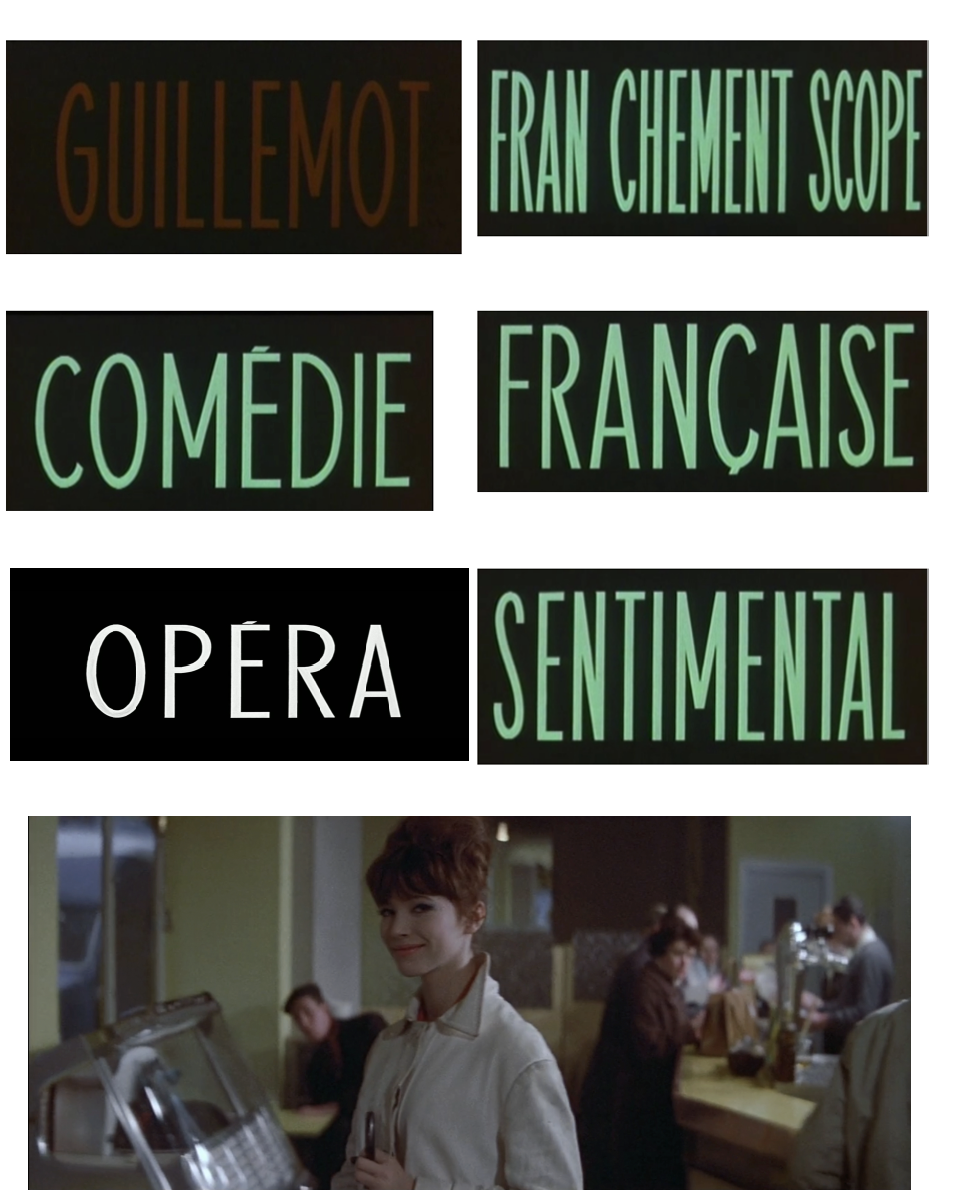
Screen stills; visual ungrammaticalities in Une femme est une femme.
Top three rows: select title cards; bottom row: Karina breaks “fourth wall” and winks at camera.
© Euro International Films; Rome Paris Films
The subsequent title cards intercut the film’s opening live-action sequence with the essential elements that one would expect to find in titles: the technology used in filming (EastmanColor), the producers (Beauregard and Ponti), the director’s name (Godard), the cinematographer (Coutard), the composer (Legrand), the production designer (Evein), and the film editor (Guillemot). But Godard, ever the contrarian, presents these names on their own, without any clarification as to what their role in the film’s creation might actually have been; although general audiences might have been able to surmise that Godard was the film’s director, would the names Ponti, Coutard, or even Legrand have meant anything to the majority of viewers? To further muddy the waters, Godard presents alongside the credits a bewildering assortment of other words: “FRAN CHEMENT SCOPE” declares one card, basically illegible to anyone but Godard, but apparently a pun on the film’s screen format, “Franscope,” combined with “franchement” (Rosenbaum 2003)—a “frank” admission of the film’s artificiality. We are next treated to cards that seem to indicate that the film’s genre is a hybridity: “COMÉDIE” says one card, followed immediately by “FRANÇAISE.” Subsequent cards tell the audience that the film is “MUSICAL,” “THÉÂTRAL,” “SENTIMENTAL,” and an “OPÉRA.” As Michael Baumgartner has pointed out, critics ever since “have struggled to define the film’s genre” (Baumgartner 2022, 224).
Sonic elements contribute powerfully to this Verfremdungseffekt. Une femme’s titles begin underscored by the sound of an orchestra tuning and the chaotic chatter of a roomful of musicians getting set up. The effect is as if we are about to watch a silent film with live orchestral accompaniment, and, as the title cards begin rolling, the orchestra is running just a bit behind. The next sonic gesture cues the main names that audiences grasp onto for meaning when viewing a film: those of the actors. Anna Karina’s voice exclaims in English, “Lights, Camera, Action!” as her name and those of co-stars Jean-Claude Brialy and Jean-Paul Belmondo flash on the screen.3 Here, Godard uses yet another standard cinematic convention—the voiceover—in an unconventional way. The acousmêtre, the disembodied, recorded voice distinctly disassociated from the images on the screen, most often directly addresses the audience, an acknowledgment of the artificiality of the cinematic experience (Chion [1982] 1999, 140). But voiceovers also generally provide some psychological insight into a main character or exposition for a complex plot, acting as a narrative equivalent to the photographic establishing shot.4 In this case, Karina simply speaks as Karina herself—or perhaps as Godard (why, in fact, isn’t it the director’s voice that we hear commanding the lights and the camera?)—announcing the beginning of the filmic experience. The exclamation is artifice at its most artificial.
And now, with that excited “action!” proclaimed by Karina, we get the name of the film in a large, red title card superimposed over the first images of the narrative. This event would traditionally be greeted by a surge of orchestral underscoring, something to signal to us that the film’s title is important. Instead, we get nothing but silence; not even foley or sound effects accompany the title card and onscreen action. Then, suddenly, Charles Aznavour’s “Tu t’laisses aller” scratches onto the soundtrack. Audiences in 1961 would have been familiar with this number one hit from 1960, which was still ranking in the French charts in 1961 (Baumgartner 2022, 133). They thus might have been alarmed that the song begins strangely, about thirty seconds from its end, accompanying shots of Karina as the main character, Angela, entering a Parisian coffeeshop. Dialogue ensues as Angela and another café patron order drinks, but their words are rendered virtually inaudible, as the level of the music remains frustratingly high. Perhaps, audiences might muse, the song’s lyrics can help aid understanding, by either “speaking” for the characters or by reinforcing “the narrative and generic themes of the film” (Smith 1998, 168). But any attempt to read the relationship between the song lyrics and the character to whom we are introduced yields, at this early moment in the film, pretty vague results: “Redeviens la petite fille / qui m'a donné tant de bonheur” [Become again the little girl / who gave me so much happiness]. Aznavour’s song shares the perspective of a disgruntled married man, who complains that his wife has “let herself go,” reminding him of his mother-in-law; he dreams of a day when she might transform back into the younger woman whom he once loved. These seem odd words to pair with the youthful and lithe (and, we will soon learn, unmarried) Angela.
As Aznavour’s song concludes, Angela drops a quarter into the jukebox, which then goes silent. What is the meaning of this clever inversion of the logical sequence of events? Godard doesn’t provide the audience much time to contemplate; after a few seconds of uncomfortable silence, the beginning of “Tu t’laisses aller” scratches onto the soundtrack, just in time for Karina’s next muffled lines, which inquire about the time, proclaim that the coffee is too hot, and announce that she has to leave. Angela turns, walks toward the coffeeshop door, and then breaks a cardinal Hollywood rule by spiking the camera (see again Figure 2): she looks directly into the lens, smiles, and knowingly winks at the theatrical audience. At that moment, the soundtrack breaks the fourth wall just like Angela/Karina does, as Aznavour’s voice croons, “It’s funny how funny it is to look at you” [C’est drôle ce que t’es drôle à regarder]. With this clever Sonimage, Godard announces that he is enjoying toying with his audience.5
As the next sequence begins, Aznavour’s song cuts off abruptly, and we again sit in uncomfortable near-silence as we watch Angela walk through the Paris streets. The only sound now is carefully timed foley matching her heels as they hit the pavement. Foley is typically the most un-marked, “inaudible” (in Gorbman’s sense of the term; 1987, 76–79) sonic element of classical Hollywood soundtracks, buried within a rich sonic palette of diegetic and nondiegetic sound; divorced from any accompanying sound, Godard’s foley effects here are mannered, bizarre, rendered psychologically unnatural, pointing out the unnaturalness of the whole cinematic enterprise. Seconds later, diegetic city sounds erupt from the loudspeakers, fully displacing the foley effects. Suddenly, Godard again plunges the soundtrack into more silence. Then, as Angela makes her way into a bookstore, nondiegetic music by Michel Legrand bursts onto the sonic foreground, completely drowning out the previously loud car horns and newspaper salesmen and continues unabated, superimposing itself over the opening lines of the next sequence rather than making space for the dialogue to establish the scene (Musical Example 3). Godard’s technique makes certain that the audience notices the cue, which serves as the score’s single identifiable nondiegetic leitmotif, representing Karina’s character and her desire to have a child. Despite his use of standard leitmotivic practice here, Godard also openly violates the classical Hollywood norm, which “sneaks” musical cues under dialogue or other sonic effects, creating a slick, professional semblance of seamlessness. Godard simply metaphorically drops a needle onto an imaginary record player, allowing the music to crash unceremoniously onto the soundtrack, thereby flaunting the rules of the cinematic sociolect.
Musical Example 3
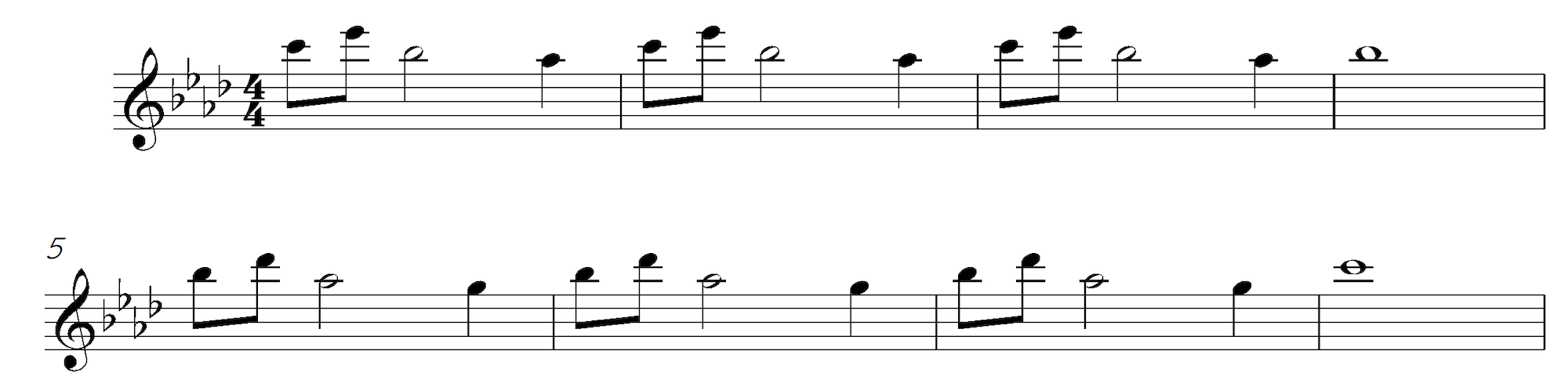
Une femme est une femme, Angela’s leitmotif.
Godard’s cinematic approach is one comprised of ungrammaticalities of Riffaterre’s first sort: cinematic elements “that seem somehow inappropriate.” His films employ sonic/visual effects that violate the norms of cinematic grammar, thereby leading us to pause and to ask ourselves what his films mean—and what film more generally means. “Deviant character has a deictic function” (Riffaterre 1978, 134); Godard’s ungrammaticality “reflects the grammaticality of the latent text (or intertext) from which the significance derives” (Riffaterre 1981, 231). To interpret what we are faced with, we are forced by Godard to participate in “an active rather than passive perception of textual facts,” to “shift from linear to intertextual reading” (Riffaterre 1981, 238). Viewers must recognize that Godard’s films are doing something that films don’t normally do; in order to recognize that fact, we must think about other films. Godard’s irreverence and originality are made possible only because they recognize the authority of the established sociolect; each ungrammaticality connects a work “with a generic or thematic intertext” and simultaneously defines its “originality by opposing it [self] to this intertext” (Riffaterre 1981, 232–233).6 The significance of such self-consciously intertextual work “tends to be the perception of form,” hence coming “very close to being a mimesis of the literary [or in this case filmic] act itself” (Riffaterre 1978, 124). Interpretation of the sonic elements in Godard’s films requires us to think intertextually—that is to say, interfilmically.
The Ungrammaticality of the Grammatical
One of the benefits of this radical cinematic approach is that it helps us to realize that non-radical, quotidian cine-musical practices are no less ungrammatical than Godard’s most idiosyncratic techniques. The legibility of Godard’s sonic and visual provocations depends on the audience’s familiarity with mainstream cinematic codes. His works do not invent new audiovisual languages so much as estrange familiar ones, violating cinematic norms and the expected grammar of audiovisual relationships. Such norms, when examined closely, are themselves built on ungrammaticalities, particularly well described by Riffaterre’s second category: ungrammaticalities produced by elements “unmotivated within the narrative or description.”7 Attention to this type of ungrammaticality illustrates that the seeming coherence of classical film style, particularly in its use of nondiegetic music, relies on the same processes of interpretive reconciliation that Godard demands.
Godard’s parodies sometimes point with laser precision to Hollywood’s weirdest sound practices that many audiences simply accept as the normal sociolect of cinema. To return to Une femme once again, we might consider a scene in a bar, in which Karina’s character performs a singing, dancing quasi-striptease (08:40; see Clip 2). The scene has markers of the traditional Hollywood musical. It begins backstage, a trope so common that entire swathes of films are referred to as “backstage musicals” (or, in more scholarly circles, “aggregate musicals”), blending staged musical performances with unstaged dramatic action (Rubin 1993, 14–19).8 While backstage, Karina avoids direct address to the camera; when she begins her stage performance, she sings directly into the lens, a standard practice in the film musical. As in many musical sequences, Karina’s performance is firmly rooted diegetically, with a shot of a pianist in the background (as well as, confusingly, a shot of her cuing up prerecorded music on reel-to-reel tape; the pianist never actually touches the instrument’s keys). But when she starts singing, Godardian weirdness ensues: all sound drops out of the scene except for Karina’s voice, and no instruments accompany her singing. When she stops singing, the piano crashes back onto the soundtrack for an interlude, and it promptly stops when she sings a second verse, leaving her voice alone to consume the entire sonic space.
Clip 2
Une femme est une femme, Karina’s piano accompaniment drops out mid-song (08:40).
Credits: © Euro International Films; Rome Paris Films
Permalink: http://lee02.revue-emergences.fr
The ungrammaticality here forms a matrix with musical films. Many Hollywood musicals contain at least one number that, like the bar scene in Une femme est une femme, establishes a diegetic space with sound-producing props: a piano, in this case. Logically, the only instrument that we should hear is the one that we see on screen. But as the singing gets underway, the typical musical enacts a moment of apotheosis, a grandly heightened emotional expression, with a full orchestra swelling onto the soundtrack—the so-called “audio dissolve” (Altman 1987, 62). So when an offscreen orchestra wells up, it is ungrammatical within the diegetic space, just as it would be ungrammatical (in fact, impossible) within noncinematic reality.
Despite the obvious impossibility of such moments in the real world, devotees of the musical accept (and even anticipate) such moments, because within the sociolect of the musical, the audio dissolve is, in fact, grammatical. Godard’s treatment of this paradigmatic musicals technique is an inversion, an antonym, a “reverse audio dissolve.” The ungrammaticality lies in a violation of the expected norms of the genre. Film musicals are supposed to have audio dissolves that spur offscreen orchestras. That is their grammar. Godard has here invoked the musicals code in such a heavy-handed way that “semiosis triumphs completely over mimesis” (Riffaterre 1978, 10). By violating the normal procedures established by this code, he has created strangeness, legible to audience members literate in the code through intertextual comparison. “We cannot […] understand the semiosis until we have ascertained the place of the text now perceived as one sign within a system […]. Everything the text says must be fitted back into the initial code”—in this case, that of the musical—“even though it is represented in the end only conversely” (Riffaterre 1978, 11).
Godard’s audiovisual inversion highlights the strangeness of the film musical. It emphasizes that the audio dissolve, while “grammatical” within the context of the musical, is itself as ungrammatical within the putative diegetic “reality” of the film world as it would be within our extrafilmic lives. In our acceptance of the illogical lies the importance of intertextual understanding: the ungrammaticality within the sociolect of everyday reality (and by extension the assumed reality of a narrative diegesis) is rendered grammatical by a group of idiolects that together form a tradition, an alternative sociolect on which interpretation can rest: the genre of the musical.
In non-musical cinema, the fracture between reason and cinematic magic is even more stark, though usually covered by technical artifice. Audio dissolves in narrative contexts typically accompany moments of high emotional charge, providing psychological suturing, an illusion of entry into characters’ innermost feelings, made possible by crossing what Robynn J. Stilwell has called the “fantastical gap” between diegetic and extradiegetic music (2007). They are among Hollywood’s favorite devices for depictions of romance. A scene from Shakespeare in Love (John Madden, 1998; 26:54; Clip 3 and Figure 3) illustrates the typical procedure. Shakespeare makes his way into a party, where live musicians and dancing entertain the guests. The music here is rendered diegetic both by visual means (the camera shows Renaissance instruments in the establishing shot) and by dialogue (Shakespeare interacts with the musicians about their activities). At this party, Shakespeare spies his future love interest, Viola de Lesseps, for the first time, and he joins the dancing to meet her. While the dancing continues, dialogue between various characters alternates with the diegetic music. But when Shakespeare and de Lesseps touch hands and gaze into each other’s eyes, an offscreen romantic orchestra takes over, swelling to the foreground of the soundtrack, enveloped in artificial reverb.
Clip 3
Shakespeare in Love, an offscreen orchestra swells as Shakespeare and Viola touch hands (26:54).
Credits: © Universal Pictures; Miramax
Permalink: http://lee03.revue-emergences.fr
Figure 3
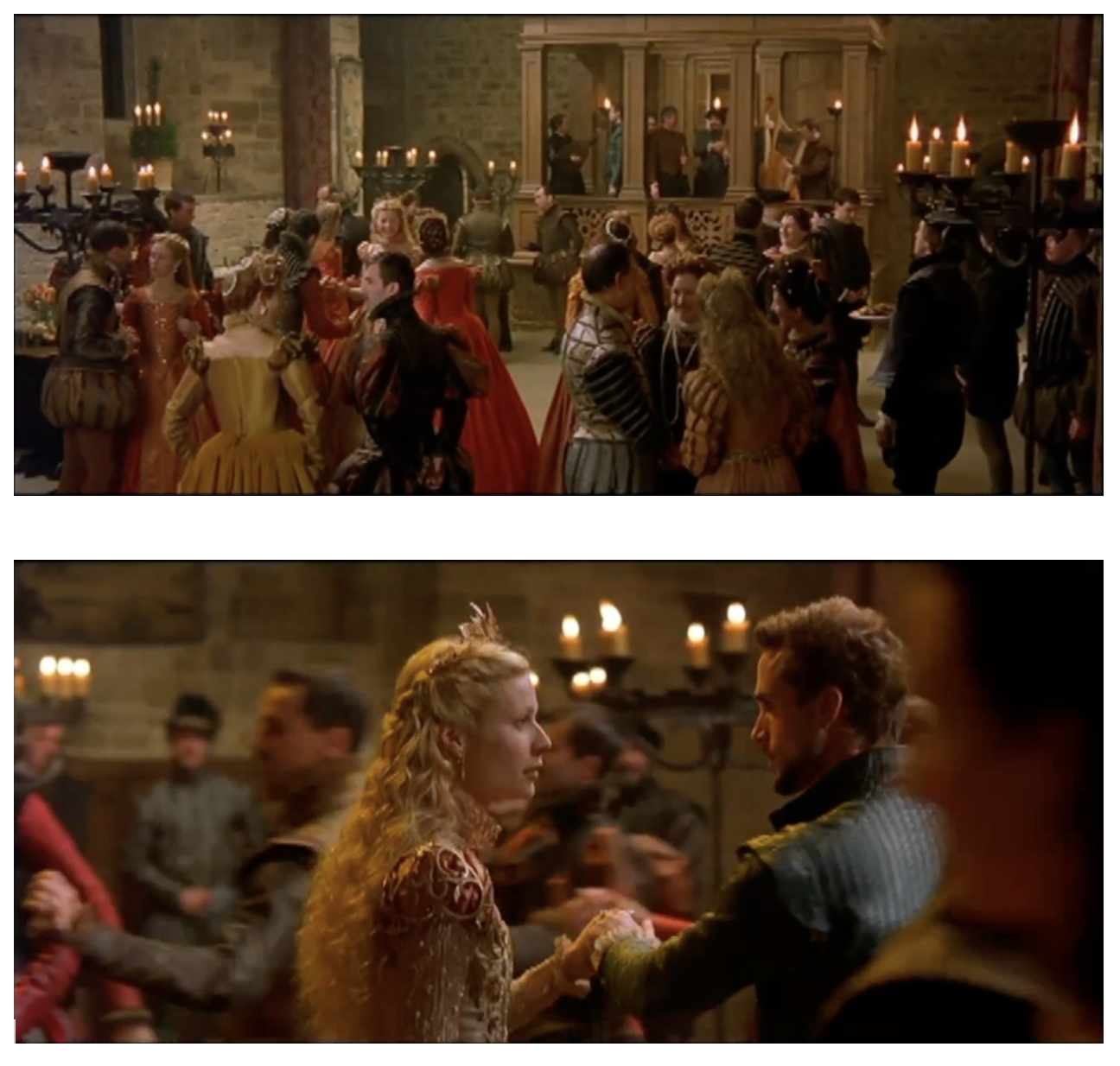
Shakespeare in Love (26:54).
Top: establishing shot shows musicians, rationalizing diegetic sound; bottom: as main characters touch for the first time, the camera’s focus shifts to them and nondiegetic underscoring swells on the soundtrack.
© Universal Pictures; Miramax
A straightforward reading of the emotional meaning here is that these characters have experienced love at first sight, reinforced by various cinematic norms: the visual cues of close camera angles, the body language of the actors, a bokeh effect keeping only Shakespeare and de Lesseps in shallow focus, and the prolonged silence between the characters as we watch them watch each other. But the primary factor that allows us to interpret the scene is the soundtrack, the entrance of the lush scoring; no true love, it seems, can bloom in Hollywood without the accompaniment of soaring strings. The orchestra intrudes into the Renaissance world. It drowns out the lutes and recorders of the diegetic reality. It is wholly ungrammatical within the diegesis, but with the help of intertextual reference, easily comprehended by a film audience.
One need not leave the comfortable realm of Hollywood to find direct intertextual points of reference, of course. The incorporation of the audio dissolve to signal heightened emotion in Shakespeare in Love has many predecessors; the most famous is surely the café scene from Casablanca (Michael Curtiz, 1942), so well-known as to need only the briefest of descriptions. Ilse sits, listening to Sam as he performs “As Time Goes By.” Rick enters the scene, angrily demands that Sam stop playing that tune, and then a stinger punctuates the sonic space of the film. “In the blink of an eye, like walking through Alice’s mirror, we are in the nondiegetic looking glass world” (Stilwell 2007, 186). For the remainder of the scene, we hear composer Max Steiner’s original underscoring, which constantly incorporates the opening melodic phrase of “As Time Goes By.”
Read within the diegetic contexts of the films that house them, these audio dissolves are sudden and heavy-handed ungrammaticalities, wresting us from the world of diegetic music to that of nondiegetic underscoring. They spur questions. Why does Rick become angry at hearing “As Time Goes By”? Why does that tune repeat in the orchestral underscoring? What are Shakespeare and de Lesseps thinking as they dance and gaze into one another’s eyes? Do they hear heightened, orchestral music as they dance, or are we “hearing” their feelings of love and excitement?
Traversing the fantastical gap demands interpretation. Violations of its boundaries aim to capture audience attention, to communicate something profound about characters’ psychology, the action on screen, the emotional charge of words spoken or unspoken, actions seen or unseen in the diegesis. We return to Alice’s looking glass: “The thickness of the glass, as it were, like any liminal space, is a space of power and transformation, of inversion and the uncanny, of making strange in order to make sense” (Stilwell 2007, 186; emphasis added). Audio dissolves are strange, indeed. But as media-literate viewers, we “make sense” of such moments in any idiolectical cinematic expression—i.e. any individual film—with ease, drawing on the contractual, non-mimetic sociolect of other texts (filmic, operatic, melodramatic, theatrical) for interpretive clarity.
The Grammaticality of the Ungrammatical
The transitional device of the audio dissolve helps this essay itself transition to a recognition of the centrality of ungrammaticality to the film music experience. The concept of ungrammaticality might be applied not only to the unusual or special, but to average, everyday cinematic (and televisual) experiences. Even the most seemingly “normal” cinematic conventions are built on semantically unstable ground. They draw on the same principle that undergirds Godard’s provocations: film meaning arises not from mimeticism, but from intertextual negotiation. Indeed, nondiegetic music in narrative cinema relies fundamentally upon ungrammaticality for its communicative power.
Michel Chion has argued that the multimedia combination that he calls “audio-vision” is a “contract” between filmmakers and viewers establishing the necessity and relatedness of separate multimedia streams. Some sonic elements receive motivation from within the image—Chion calls this a perception of a “physical and mechanical phenomenon”— while others require something intertextual in the contract (Chion [1990] 1994, 20–21). To illustrate, Chion compares insect sounds with orchestral music employing pronounced vibrato. Both, he argues, “have on the dramatic perception of time exactly the same effect of concentrating attention and making us sensitive to the smallest quivering on the screen.” But insect sounds and musical underscoring demand different strategies of interpretation, with a marked distinction between “a string tremolo in a pit orchestra, which the viewer perceives as a cultural musical procedure, and the rustling of an animal, which the viewer perceives as a natural emanation from the setting.” In Chion’s assessment, sound effects and music cues serve similar functions, but the former are rooted in the image, while the latter have “nothing of the mechanical: founded on a psychophysiological basis, they operate only under certain cultural, aesthetic, and emotional conditions by means of a general interaction of all elements.” In other words, Chion argues that nondiegetic musical cues depend upon intertextuality to generate meaning. They are, by definition, ungrammaticalities within the narrative frame.
We might be so bold, then, as to say that nondiegetic music in cinema is fundamentally itself an ungrammaticality. There are no romantic orchestras (or rock bands) in outer space, the jungle, or Renaissance courts. David Neumeyer points out that music, “except in performance and perhaps in spectacle and in mute emotion, really has no place in the cinema except by the historical coincidence of certain theatrical conventions” (Neumeyer 2015, 43). Film music scholarship has often highlighted the central importance of these “conventions” to narrative cinema’s broad aesthetic appeal. Music provides psychological suturing, binding us to the characters on screen, to the place where the action takes place, or to one another in the theater (Gorbman 1987, 53–69). What music has contributed since the days of synchronized sound is the sense that “the talking film was […] something other than a recording of the world. The principle of psychological realism governing narrative film requires such stratification—that is to say, the audio-viewer must be given a means to discern that the world depicted is not simply what is seen and heard but something more or other than what it appears to be” (Neumeyer 2015, 43). Music serves as the place of emotion, of fantasy; where music and image meet to communicate, there we find what Peter Franklin deems cinema’s “central pleasure zone” (Franklin 2001, 91). For this zone to have its pleasing effect, we audience members must interpret it, understand the contract, and accept its narrative ungrammaticality.
This means, of course, that we in turn must accept nondiegetic sound’s centrality—in effect its grammaticality—within the cinematic sociolect.9 Music, on the one hand, can be considered a technical cinematic device no more separable from cinematic products than any other: “traditional nondiegetic music does not usually seem problematic despite its apparent lack of motivation: its indifference to acoustical fidelity is unmarked, since music, when treated this way, can be understood as a stylized background—like stylized sets or lighting” (Neumeyer 2015, 41). On the other hand, from many audience members’ perspectives, music is something more than a technical element; it is a site of magical access to emotional charge and psychological depth. Berthold Hoeckner has illustrated how the development of synchronized sound film created a “new mode of audio-visual intertextuality,” a collective “optical-acoustic unconscious” into which we all tap when we watch film (2019, 3, 5). Without access to that cultural intertextual storehouse, cinema would cease to be cinema and would instead be no more than what it is mechanically: a series of images overlaid with myriad sounds. Chion reminds us that “there is no image track and no soundtrack in the cinema, but a place of images, plus sounds” ([1990] 1994, 40, see also 1982, 13–14). That “place” is the site of Hoeckner’s collective intertextual, multimedia memory, the Riffaterrean hypogrammatic sociolect of cinema itself. Riffaterre argues that there is a hypogram of the poetic, with certain words “perceived as permanently poetic […]. ‘Dawn,’ for instance, is so predestined—we know instinctively that it is a poetic word; we know that ‘grove’ is more poetic than ‘clump of trees,’ though both may be talking about the same copse” (Riffaterre 1978, 42). We similarly recognize the combination of emotionally charged nondiegetic music, narrative, and patterns of image sequences as a hypogram that we call “cinematic.”
If this alchemical reaction between image and nondiegetic sound is the cinematic hypogrammatic model, then that model itself can be violated, creating moments of explicitly cinematic ungrammaticality that demand interpretation. One final example, from television’s Ginny & Georgia (Netflix, 2025; “Friends Can Dance,” 02:45; Clip 4 and Figure 4), will suffice to illustrate the point. In this scene, Georgia has been confined by a judge to house arrest while she awaits trial. Previously a social butterfly and prominent member of a small town’s society, Georgia suffers deeply from a sense of isolation and cabin fever. To cope, she sits on her front porch, spying on her neighbors with binoculars.
Clip 4
Ginny & Georgia, S03E03 « Friends Can Dance », a seemingly nondiegetic song is revealed to be diegetic (02:45).
Credits: © Critical Content; Netflix
Permalink: http://lee04.revue-emergences.fr
Figure 4

Ginny & Georgia, S03E03 “Friends Can Dance”, screen stills and descriptions of sound in two scenes (02:45).
© Critical Content; Netflix
As Georgia gazes across the street at a neighbor’s actions, “Summer Song” by Remy Bond plays in the soundtrack’s foreground. The song’s introduction precedes the establishing shots of the sequence, sneaking in under lines of dialogue between other characters and acting as a sound advance to smooth the transition between scenes. We therefore initially perceive the music as nondiegetic, since it begins at a moment of narrative disruption and since the music obviously does not emerge from any visual source in the preceding dialogue scene. Further, we can read the song as reflecting on Georgia’s plight. Its lyrics describe freedom of movement: “In the summertime, / Driving up the west coast, / Me and my valentine, / We ain’t got no place to go, / Nothing ahead but the open road.” Trained as we have been to associate popular song lyrics with narrative scenarios and character perspectives (Gorbman 1987, 19–20; Smith 1998, 168; Lee 2021, 301 ff.), we naturally interpret this audiovisual combination as an illustration of Georgia’s suffering; she listlessly sits on her porch, watching the world around her and dreaming of the type of freedom described by the song’s lyrics.
But then, as we see a closeup of Georgia, eyes pressed tightly to binoculars, we hear a muffled, unintelligible offscreen voice intrude upon the song. The camera shifts to another character, shot from a high angle (Georgia’s point-of-view), waving her arm and repeating the muffled word: “Georgia!” Georgia reaches up and removes a previously unshown earbud headphone from underneath her hair. Bond’s song, unceremoniously interrupted, fades immediately from the soundtrack, and dialogue takes over.
The entirety of this sequence lasts just a few seconds, yet sophisticated multimedia play rapidly ensues. The music begins, with the sound advance, as a transitional device between scenes, easing the audience’s perception of change of location and character focus, placing the music in the nondiegetic sphere. As we see Georgia on her porch, we associate the song’s assumed nondiegetic lyrics with her confinement and longing for freedom. When the second character enters the scene, the muffled voice that interrupts the sonic foreground illustrates Georgia’s point-of-audition, just as the camera illustrates her point-of-view. With a fluidity so rapid as to be almost instantaneous, we reinterpret the musical sound as diegetic. The cinematic hypogram has been shattered, the audiovisual contract renegotiated.
What makes comprehension of this sequence possible, what predicates our understanding of the shifting terms of the audiovisual contract, is ungrammaticality. The multimedia montage has drawn upon the sociolect of cinema to position the background music as extradiegetic commentary; then the multimedia apparatus pulls the rug out from underneath us, forcing us across the fantastical gap. Within the terms that the sequence has set up for us, the second character’s muffled voice and the sudden cessation of Bond’s song are surprises, ungrammaticalities. Yet they simultaneously highlight that the sound advance and extradiegetic function of the song within the narrative space were themselves initially ungrammaticalities that had required our interpretive work. To understand the shift from nondiegetic music to diegetic sound, we first must have comprehended, on some level, the sound advance and sonic foregrounding as intruding upon the putative realism of the previous scene, contributing to the scene change. Ungrammaticality interpreted and understood becomes grammaticality, in turn interrupted by an ungrammaticality from the diegetic space, forcing us to re-rationalize the music as part of the diegesis. Understanding the audiovisual relationships in something as seemingly unproblematic as episodic television in fact requires a sophisticated degree of literary competence, a familiarity with the terms of Chion’s “contract” established within the bounds of a cultural sociolect that is broadly understood, but hardly natural or mimetic.
Riffaterre’s concept of the ungrammaticality, like so many intertextual theories, helps us to train analytical attention on reception rather than production. Yet it is also firmly rooted in structural evidence, inviting and informing close readings of cinematic practice. The analytical approaches in this essay might be extended to consider other elements of the soundtrack, such as sound effects, norms of the dialogue track, the intertextual history of foley, and more. Within the realm of film music studies, the usefulness of the ungrammaticality lies in its ability to help us explain the importance of intertextuality to audiences as they interpret both unusual and quotidian moments of cinematic viewing.
Disruptions of the cinematic hypogram, whether radical like Godard’s Sonimages, marked like the audio dissolve, or fleeting like the headphone conceit in Ginny & Georgia, remind us that film is not mimetic, but a form of expression that finds its meaning through intertextual reference. Within a mimetic reading, nondiegetic film music is at its core an ungrammaticality. It has no place within the narrative. It is illogical. Yet we accept it as a grammaticality within the sociolect established by a long tradition of idiolectical cinematic creations, a fundamental part of the audiovisual contract that embraces unreality in exchange for multimedia wonder, whose delightful “combinatoire of expression” is rendered legible through intertextuality (Gorbman 1987, 16).