We would like to thank Sara Blecher and Valérie Legrain-Doussau for facilitating the introductions with many of the filmmakers (producers, cinematographers and other technicians) that we interviewed in South Africa. Anna-Marie would like to acknowledge South Africa’s National Research Foundation for its rated researchers’ funding. A special word of thanks goes to the Johannesburg Institute of Advanced Study (JIAS) where she was based when concluding the article.
Introduction and background
The film sector1 can be productively conceived of as the articulation between three different spheres: an administered economy, market operators, and a non-market sector, a pattern we have borrowed from Françoise Benhamou as it is cited by Olivier Alexandre in his remarkable study of an “ecology” of the French cinema.2 Such an ecology is “a set of social relations” that involves a set of agents, a set of places and the relationships that are thus created and maintained between them.3 Alexandre considers that this “ecology” is a means to develop a model that can account for the “interactions between multiple elements that are neither fully constrained nor fully independent.”4 It entails considering the film sector as a “world” in the sense of Howard Becker,5 rather than as a “field” in Pierre Bourdieu’s sense,6 while teasing out the tension between freedom and determinism in the South African film and television industry, commonly referred to in South Africa as the “audiovisual industry”.7 If Olivier Alexandre’s ambition is to “explain jointly the market and the non-market, practices and values, cooperation and competition, distribution and selection, specialization and interrelation”,8 our focus is more modest. In this exploratory research, we will be concerned with interpersonal relations and cooperation among agents in the “world” of the South African audiovisual industry, and we will seek to understand how individuals describe their agency within a set of constraints that may be economic, political, institutional, cultural, gendered or racial.9 More specifically, the purpose of this article is to begin exploring the ruptures triggered by the end of apartheid in the early 1990s, and the current #MeToo movement. The latter movement began internationally, but also influenced South Africa, as it directly led to the creation in 2016 of the organization Sisters Working in Film and Television (SWIFT).10
In this article, we will provide a brief overview of the colonial history of South Africa, since the first films were screened in South Africa from 1896 onwards, and the first film footage was shot during the South African Anglo-Boer War of 1899-1902, a war where the Boers Republics fought (and lost) their independence from the British Empire.11 Thereafter we will briefly outline the South African population and its official languages that are crucial to understand the development of the film industry before, during and at the end of apartheid. In the second part, we will present the survey we conducted with members of the South African audio-visual industry and outline the complexities of film and television production in the country, and how issues differ in the three main locations—Johannesburg, Cape Town and Durban. Drawing on the first results of our survey, we focus on the first generation of entrepreneurs and then on film and television training in the country. We will then address the question of film workers’ agency in relation to the development of a career that relies on the development of networks of relationships (essential to a fundamentally collective approach to filmmaking). In the article’s third section, we will draw on the testimonies we collected to address working conditions and the ways in which women have struggled collectively to impose themselves, their films, their skills in a male-dominated industry. It is essential to highlight that this article forms part of a larger study on film technicians in South Africa, and more results will be shared in future scholarship.
Historical context of South African film production
To understand the South African film and television industry since apartheid, one must acknowledge its colonial past and complex relation to race, gender and languages. This has led to a long history of segregation in film production, distribution and exhibition12. Though Portuguese explorers were the first known Westerners to land on the so-called Cape of Good Hope, it was the premier capitalist corporation of the 17th century, the Dutch East India Company, which settled in the southernmost tip of Southern Africa from 1652 onwards. The British formally annexed the Cape Colony in 1806 and they have left a lasting legacy, as English is still the lingua franca spoken in the country.13
Prior to western colonization, the southern part of the country (of what is now known as South Africa) was mainly inhabited by the indigenous hunter-gatherers, later known collectively as the Bushmen or San. These pastoralists were collectively referred to as the “Khoe/Khoekhoen or Khoi Khoi”.14 The Black nations (or ethnic groups)15 resided more to the north, east and west of the country. After Dutch settlement, the white settlers and their workers began to speak a version of Dutch, mixed with the dialects of the Malay slaves and the indigenous Khoe, as a lingua franca to each other. This language later became known as Afrikaans, and was spoken by the white settlers but also by local nations descending from the Khoe, like the Griqua16 and the so-called “Coloured.”
“Coloured” in the South African context is not a racial slur for Blacks (as it is in the USA). It is an official category operative both during and after apartheid (including in South Africa’s census of 2022). It refers to a ethnic and cultural group that descends from South Africa’s indigenous people—the Khoe as well as Malaysian slaves, the amaXhosa and the early White settlers. These early settlers had extra-marital affairs with slave or Khoe women, but also married “free slaves.”17
From 1680 onwards, a vast migration took place from the south to the north of the country, as the settlers searched for new grazing grounds. These white settlers were originally known as Voortrekkers (front trekkers), but since most of them were farmers, their ancestors were referred to as Boers—the Afrikaans word for farmer. Various wars between the colonists and the Black nations of the country broke out that lasted until British annexation of the country in the 19th century. By the 19th century, the Boers became known as Afrikaners.18
In 1896, the first film was projected and exhibited at the Empire Palace of Varieties in Johannesburg, then part of the Boer Republic called the Zuid-Afrikaansche Republic (ZAR). This city attracted a large number of migrants to work in the mines, and “magic lantern” shows formed part of a bustling entertainment industry.19 When Thomas Edison’s kinetoscope opened to the public in a rented shop in Henwood’s Arcade in Johannesburg, “the machine with its few 15-foot loops of film which had to be threaded onto rollers in its interior, attracted thousands of people to press a coin into its slot and to gaze in astonishment to the ludicrous [film] scenes within.”20
British interest in the large mineral deposits in the ZAR eventually led to the South African Anglo-Boer War. After the Boers lost the war in 1902, these territories, along with Natal, were ruled by the British. It was the establishment of a British dominion, called the Union of South Africa, in 1910 that led to the creation of South Africa.21
Many of the laws that discriminated according to race were implemented during British rule. The Mines and Work Act of 1911 granted “competency skills certificates” for various skilled mining occupations to White and Coloured workers only.22 In 1913, the Natives Land Act drafted by Cecil John Rhodes, prohibited Black, Indian and mixed-race South Africans from buying or hiring more than 7 % of the country’s land.23 Therefore, from the early twentieth century onwards, film audiences were separated according to race, each race having “its own set of rules and operations, feature films and cinemas.”24 As early as 1917, legislation such as the Cinematograph Film Ordinance included clauses that prohibited scenes depicting animosity and conflict between “Europeans” and “non-Europeans,” as the government feared that audiences would imitate what they saw on screen.25
In the 1920s, Reverend Ray Phillips of the American Board of Missionaries used film to moralize migrant workers at the Witwatersrand’s mining compounds. Phillips later wrote that he carefully selected the films to be screened to ensure that the content would provide “clean” and “wholesome” entertainment. Furthermore, he often cut out parts of the film that in his words might have had a “questionable influence on the natives.”26 Later on, South Africa’s Entertainment Act of 1931 demanded censoring film scenes where “Europeans and non-Europeans intermingle”, while a 1934 amendment to the Act prevented film screening societies (especially those with Black members) to screen “communist propaganda.”27 By 1939, the Johannesburg newspaper The Star reported that the Union Board of Film Censors had to approve feature films as suitable for exhibition to natives” before it could be distributed to cinemas and other exhibition spaces.28 In the 1940s, the first films aimed at Black audiences were produced, with Jim Comes to Joburg (Donald Swanson, 1949) featuring an almost exclusively Black cast, however it was directed and produced by white filmmakers.29
In 1948, the National Party won the elections and implemented its apartheid’s policy which began with job reservation for White men, but later evolved to legislated racial segregation in all aspects of society. Apartheid laws included the Mixed Marriages Act, which prohibited marriage between those of different races, the Race Classification Act, which classified the population into four racial groupings, namely White, Coloured, Black and Asian, and the Group Areas Act, which segregated areas according to race and determined that different population groups could not reside in the same area.30
With the Publications and Entertainments Act of 1963, the South African government established the Publications Control Board (PCB). This law forced film producers to submit their films to the PCB before they could distribute them to cinemas.31 If a film carried a critical message about the apartheid ideology, the PCB would ban it outright. If a film criticized the National Party government or problematized the country’s racial policies, the censors demanded extensive cuts to the film.32
In the 1950s, the South African government introduced a subsidy system to stimulate the growth of the local film industry and to enable South African filmmakers to compete with their international counterparts. According to Keyan Tomaselli, “an immediate result of the subsidy, particularly in the mid-1960s, was the production of feature films which successfully competed with imported films on local circuits.”33 He calls the period between 1965 and 1967 a time of “innovation, of social criticism and the exploration of cultural themes.”34 Jans Rautenbach’s controversial film Katrina (1969), narrating a story about a coloured woman and her family suffering from apartheid’s racial classification system, was almost banned by the censor. After significant pressure from the White intelligentsia, spearheaded by Schalk Pienaar, the then editor of the Afrikaans newspaper Beeld (Image), the film was released.35 Katrina was critically acclaimed locally and internationally, and it earned R 900 000 at the South African box office.36 However, Rautenbach’s œuvre is considered to be an exception to the rule. Many filmmakers, like dissident filmmaker Manie van Rensburg,37 complained that the subsidy system rewarded films of questionable artistic merit that were aimed at “the lowest public taste,”38 notably by viewers who watched films at the drive-in. Some Afrikaans films, like director Koos Roets’s film Die Groen Faktor (The Green Factor, 1984), poked fun at the apartheid ideology in a satirical manner. Its comedy and fantastical elements prevented the film to be banned, however, it also provoked newspaper critics to write it off as mere “slapstick comedy,” a point critiqued much later in scholarship.39
While films targeted at Black South African audiences were made since the 1940s, Martin Botha and Jacqueline Maingard argue that the 1970s brought an increased attempt to create a so-called “Black film industry”. However, Botha states that this resulted in “a large number of shoddy films in black ethnic languages that were screened in churches, schools, community and beer halls.”40 These venues were located mainly in townships outside of predominantly White cities, “since it was contrary to government policy to allow Black cinemas in the urban White areas.”41 In keeping with apartheid policy, filmmakers depicted Black characters’ lives in the city as negative experiences, while life in the Black homeland was portrayed positively.42 Notable exceptions include Louis de Witt and Tonie van der Merwe’s Joe Bullet (1973) and Viriato Barreto’s Knock-Out (1969). Because of its segregated nature, scholars lamented that “a true national” film industry could not emerge from either the Afrikaans film industry or the “made-for-Blacks” film industry.43
The introduction of television in South Africa in 1976, contributed to a sharp decline in cinema admissions as well as in the number of locally produced films.44 Thus, an amendment to the subsidy scheme was introduced to assist producers during a period when cinemas, drive-ins especially, were closing down. Another result of the “sluggish conditions” caused by television was the merging of two major distribution and exhibition companies—Ster and Kinekor. Though they were previously both owned by one holding company, Satbel, the merger of the two companies into one—Ster Kinekor—“trimmed previously duplicated staffs, concentrated on the acquisition of large budget blockbuster movies and integrated publicity and advertising into more efficient formats” which could lure more audiences to the cinemas.45 In 2022, Ster Kinekor still holds the monopoly of cinema theatre chains in South Africa, with only one company, Nu Metro, as its main rival.
In 1985, South African cinemas were finally desegregated.46 In fact, Ster Kinekor closed cinemas in cities or towns where the segregated status quo was maintained, in the hope of appeasing the rising international cultural boycott against South Africa.47 The years thereafter are regarded by Botha and Tomaselli as “the turning point” and “a new wave” in the South African film industry, as many of the films produced in this period were critical of South African realities, including the consequences of its colonial history and apartheid. These films dealt with issues such as Black and White conflicts and friendships, the poor treatment of mine and farm workers, the effect of the Namibian war on Whites, terrorism and the trauma of racial conflict. In the 1980s, one also saw the entry of Black film producers into the South African film industry, such as Simon Metsing. The producer Peter Sephuma, who portrayed the lead role in the film My Country, My Hat (David Bensusan, 1981) also owned and managed his own production company.48
A notable role player in the South African film landscape that entered the industry in the eighties is the producer and distributor Anant Singh. Singh collaborated with the director Darrel James Roodt in making films critical of apartheid. While most filmmakers at the time were steering clear of this controversial subject, out of fear of losing funding or audiences for their films—Singh did exactly the opposite: he identified suffering under apartheid as a sellable commodity—among South African and American audiences. To distribute Roodt’s anti-apartheid film Place of Weeping (1986), Singh bypassed South African distributors and contacted the North American distributor, New World Films directly.
Had he not, [Roodt and] Singh’s films may well have become another statistic of failure at the Department of Industries’ subsidy office, along with films made by Ross Devenish, David Bensusan and Manie van Rensburg.49
According to Botha, about 944 feature films and 998 documentaries were made in the 1980s, yet most of these films were mostly inaccessible to South Africans because of censorship, lack of distribution and poor audience attendance. Some South Africans could watch thought-provoking and aesthetically superb films at film festivals like the Durban International Film Festival (founded in 1979) and at tertiary institutions like the campuses of the University of the Witwatersrand and Cape Town, or at private residences. However, these film screenings were in the vast minority. Problems related to cinema distribution and segregated channels on the South African television operated by the South African Broadcasting Corporation (SABC) meant that it was often “easier to view [South African] films in London, Amsterdam and Paris than in South Africa.”50 As a result, by the 1990s, South Africa had a “fragmented film industry with fragmented audiences.” A lot of this fragmentation has to do with the many cultural groupings that comprise the South African Nation, each with its own identity, traditions and language.
The South African Population
South Africa has a population of 60.8 million people according to the country’s 2022 population estimation, conducted by Statistics South Africa (StatsSA).51 South Africa has eleven official languages, namely Afrikaans, English, isiZulu, isiXhosa, isiNdebele, Sepedi, Sesotho, Setswana, siSwati, tshiVenda, Xitsonga. The pie chart below shows the distribution of home languages or “native tongues.” All of these ethnic groupings have their own distinct cultures and traditions. Thus, even if most South Africans speak more than one language, it problematizes the viability of a cohesive film industry. However, English is the lingua franca that is mostly used in tertiary education and government matters and is understood by most South Africans.52
Figure 1
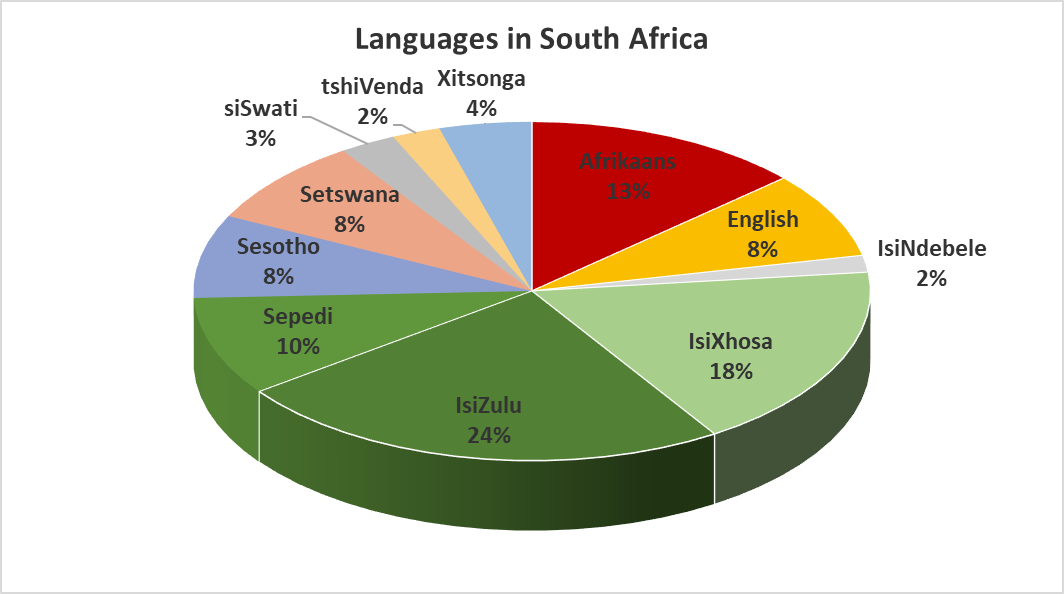
South Africa’s official languages and the percentage of home language speakers (Stats SA, 2022).
StatsSA reported in their 2021 General Household Survey that 51 % of the country’s population is female and that 42 % of all households are headed by women. The Survey’s report states that “while women empowerment is central to the global development agenda and is a steppingstone to gender equality, women in South Africa are more likely to be unemployed than men and are less likely to participate in the labour market than their male counterparts.”53 According to Stats SA’s Gender Parity Ratio (GPR) Index, gender stereotypes are still at play when South Africans choose fields of study and careers. Subsequently, the findings state that the disparity in favor of men and “the slow entry of women into specialized fields, traditionally associated with males, will delay gender representation within those fields.”54 In South Africa, the unemployment rate increased from 27,7 % in 2017 to 34,5 % in 2022, with 25- to 34-year-old South Africans being the most severely hit age group.55
An Administered Film Economy in South Africa: Market Operators and the Non-Market Sector
In the early 1990s, the National Party began with a transition of handing over power and negotiating a new constitution with members of the anti-apartheid movement. In 1994, the year of South Africa’s first democratic elections, the ANC won most of the seats in government.56 In the same year, the country’s Human Sciences Research Council (HSRC) conducted a comprehensive study on the restructuring of the entire South African film industry. The 400-page report was forwarded to the then South African Minister of Arts, Culture, Science and Technology, Dr Ben Ngubane. The HSRC research team, which included Martin Botha, recommended that government’s aid to the local film industry should be “administered by a statutory body referred to as the South African Film and Video Foundation (SAFVF).” It further stated that “all types of films, including short films, should benefit, and a developmental fund should be used to support first-time filmmakers from previously marginalized communities.”57
This comprehensive research report led a Reference Group constituted mostly of industry professionals and a few academics like Keyan Tomaselli, Martin Botha and Beschara Karam, to draw up a Film Development Strategy Document. A key recommendation was that the South African film and television industry should be administered by a statutory body,58 which in turn led to the establishment of the National Film and Video Foundation (NFVF) in 1999. According to Botha, the long-term aim of the Foundation was to facilitate the industry to become commercially viable and internationally competitive.59 Thus, since the end of apartheid, the NFVF, the Department of Sports, Arts and Culture (DSAC) as well as the Department of Trade and Industry (DTI) have been responsible for cultural policy and the implementation of international treatises and agreements. These ministries have undergone various name changes, with the Department of Arts and Culture (DAC) becoming in 2019 the Department of Sport, Arts and Culture (DSAC) and the DTI redubbed as the Department of Trade, Industry and Competition (DTIC).
The old subsidy scheme already ceased to exist prior to the NFVF’S formation, and since March 1995 an interim film fund of ten million ZAR (around 500 000 euros) was distributed to film projects. However, this was not enough to sustain a thriving film industry, and a new South African subsidy scheme, managed by the DTIC was put in place from 2010 onwards. In 2022, the incentive packages of the DTIC included: The South African Film and TV production incentive, the South African Black Filmmakers incentive, the Foreign Film and Television Production and Postproduction incentive, the SA Film and TV Production and Co-Production incentive.60 Yet, since 2021, filmmakers have complained that the DTIC’s management of the rebate system is dysfunctional. In 2025, it came to a boiling point when filmmakers and crew picketed outside the DTIC’s offices, protesting payment backlogs of up to two years. Though government spokespersons initially dismissed the DTIC’s non-payment as a bureaucratic backlog, many role players dispute this, stating that the crisis is not merely bureaucratic; it is a systemic threat to the commercial viability of local productions, undermining cash flow, investor confidence and the ability to retain talent.61
In South Africa, when television was introduced in 1976, it was entirely managed by the SABC, which held a monopoly on all local broadcasting services until the late 1980s. It is a public sector broadcaster fashioned on the BBC model in the UK.62 After the end of apartheid, the SABC was mandated by the Independent Communication Authority of South Africa (ICASA) “to play a development and nation-building role in the South African society.”63 Since the 1990s, the SABC television channels broadcast content in all of the official languages. As part of its mandate, SABC TV broadcasts a 30-minute news bulletin daily in each of these languages, except for South African Sign Language, which was made South Africa’s twelfth official language in 2023. Apart from the news bulletins, all other programming on SABC Television usually has English subtitles.64
The first pay-television channel in South Africa was established by the then Afrikaans media conglomerate Naspers in 1986. Originally, subscribers needed a decoder to access programming, however, there was one free-to-air slot which viewers could watch without having a decoder or subscription service. This was called “open time” and was broadcast daily in the late afternoon, between 5 and 7 pm. This was also the period during which South Africa’s first ever soap opera, Egoli (Place of Gold), was broadcast on MNET. This meant that South Africans who did not pay for a MNET subscription could also watch the soap opera.65 The company closed the “open time” slot in 1997 in the hope that more viewers would officially subscribe to the DSTV/Multichoice service to watch the soap operas during that time slot. According to Makhwanya Aifheli, in 2016 there were about 700 cinema screens in South Africa,66 most of them in Johannesburg, Cape Town, Pretoria, and Durban. If one combines the audiences that can be accommodated in the theatres, it totals 21 million admissions per annum, with an average ticket price R 42,9 (2,8 euros).67 By December 2022, the cost of an average film ticket had risen to R 105 (5,78 euros) for a normal 2D ticket and R 125,00 (6,89 euros) for a 3D film ticket. Prior to the Covid-19 pandemic and the resulting closure of cinemas, 26 South African films were released on average annually, which means that the film sector is not financially viable if one only considers traditional distribution models.
In terms of the non-market sector, there are many aspects of it related to the South African film and television industry. South Africa boasts many film festivals, of which the Durban International Film Festival (DIFF) is one of the longest running ones. Presented annually by the Centre of Creative Arts, which is affiliated to the University of KwaZulu-Natal, DIFF is seen as a premier platform for networking and showcasing films. It coincides with the Durban Film Market. The Silwerskermfees is an annual film festival held in Camps Bay (Cape Town) hosted by Multichoice’s Afrikaans satellite channel, kykNET. Though it was initially established by Karen Meiring and Jan du Plessis to grow the Afrikaans film industry, which had stagnated after 1994, many non-Afrikaans speaking filmmakers have lauded the festival’s talent growth and mentorship program as kickstarting their career.68 Gambit Films, the company behind the largest so-called Coloured and Malay soap opera on DSTV, Suid-Ooster (South Easter) entered their first short film as part of the Silwerskermfees talent program. Now, Gambit Films, a BEEE company, is also the driving force behind the internationally popular Netflix teen drama, Blood and Water (2020). The newest film festival is the Joburg Film Festival that had its inaugural run in 2018. Sponsored by Multichoice, and with a slogan like “Our City our Gold,” this festival boasts that it aims to anchor Johannesburg as a capital for film, streaming and television production. Though the aforementioned film festivals have secured large parts of their financing from broadcasters and satellite channels, they do have support from volunteers like film festival programmers and academic institutions. On the documentary front, the Encounters South African International Documentary Film Festival that takes place in Cape Town and Johannesburg simultaneously, is the largest of its kind on the African continent. It has been in operation since 1995.69
As mentioned before, South African academics have been involved early in the development of post-apartheid film policy, and there is a solid body of knowledge that has been produced about the South African film industry. Our research here makes numerous references to Keyan Tomaselli, Jacqueline Maingard and Martin Botha’s scholarship. There are several academic programs across the country in the arts, humanities and social sciences that focus on film. Some of these institutions will be discussed in the survey section of this article.
Film criticism is mostly limited to blogs and newspaper websites and since the major art sections of the newspapers closed down, releasing a film means relying on marketing and social media rather than on traditional film reviews. Yet, there are some radio film critics who are held in high regard, especially amongst traditional White audiences, and Black audiences have been known to discuss films after reading reviews on the online newspapers Sunday Times and Mail & Guardian. But we argue that little has been done to develop local or national film cultures in South Africa. In contrast to countries like France and India that have established cinema-going cultures, there are no incentives to encourage schoolchildren and the youth to go to the cinema. These and other issues related to the post-apartheid period will be discussed in more depth in the survey section of this article.
Conducting the survey
This research is the outcome of a collaboration between Patricia Caillé and Anna-Marie Jansen van Vuuren between November 22 and December 2, 2021, in Johannesburg and Pretoria, leading to 19 interviews as well as 6 interviews conducted online (beyond this fieldtrip). We started our fieldwork with interviewing the individual contacts Patricia Caillé developed a few years earlier, most notably with Sara Blecher whom she had solicited for a previous project on SWIFT (Sisters Working in Film and Television) and later through the cooperation of Valérie Legrain-Doussau, a consultant and producer. Co-author Anna-Marie Jansen Van Vuuren, being a film journalist and an academic in the film program of Tshwane University of Technology, also facilitated in arranging interviews with a wide range of producers, directors, technicians, as well as employees of the institutions that forms part of South Africa’s administrative film economy (DSTV/Multichoice, NFVF, and so forth).
This survey conducted in South Africa is part of a larger HESCALE project aimed at exploring the collective filmmaking process (i.e. how a group of film technicians join the film industry, get together to form a crew and participate collectively in filmmaking) through a comparative approach across several African and Middle Eastern countries. Small international teams of researchers have been working in different countries like Tunisia, Morocco, Turkey, Cameroun, Togo, and South Africa. In this research, while going beyond a role-based approach, we consider film productions or “shoots” as “temporary organizations” that “capitalize on the specialized skills of their members while keeping costs of coordination to a minimum,” and “that are governed by networks of relationships rather than by lines of authority.”70 It means that such organizations rely on “hierarchical groupings”71 that can immediately be operational on the set.72 Such “coordination across firms in these networks relies […] on social mechanisms such as reciprocity, socialization, and reputation.”73 Therefore, such temporary organizations take for granted that their workers have learned to work collectively prior to any specific contract, which means that we cannot understand how technicians work collectively without focusing on their training and first steps in the film and audiovisual sector. This is the rationale behind our survey.
In our qualitative interviews, we focus on the career paths of film producers, technicians and filmmakers as well as on their day-to-day experience of working in the film and television industry. Our research explores the interviewees’ film culture, film training, their struggles to find their first internships or contracts, their lived experience and the network of relationships that enables them to continue working in the film and audiovisual industry.
In Making Film in Egypt, Chibab El Khachab insists on using the term “interpersonal” in his extensive study of working practices in the Egyptian film industry: “all institutions in today’s industry work thanks to the interpersonal sway of individuals connected with other individuals.”74 This observation also applies to our research in the way that we proceeded to develop contacts and reach a larger community of film practitioners as we conducted the interviews.
Lastly, in considering the methodology of our research, we would like to draw attention to the status of the interview as a means of collecting data on the workings of the industry. In Gaze Regimes: Film and Feminisms in Africa75, Antjie Schuhmann and Jyoti Mistry note that
[Firstly,] filmmakers are storytellers within the narrative world of the films they make; and secondly, they tell the stories of their practice of making films: the obstacles, trials, tribulations, and triumphs. The sum of these narratives further contributes to how meaning is made and serves to enhance the understanding of the socio-cultural and economic circulation of these products as cultural and political artifacts.76
In other words, the information collected through these interviews cannot be taken at face value as it is situated knowledge inscribed within larger discourses that are inherent in the operation of the film sector and the relationships of power at work within it.
Whether they were conducted in person or on line, the 25 interviews lasted between 60 to 180 minutes. Two of Anna-Marie Jansen Van Vuuren’s students, Angel Zulu and Marcus Mogoane, both in the final year of their Bachelor in Motion Picture Production (film studies) at Tshwane University of Technology in Pretoria, participated in conducting interviews for the survey as well. The idea was for them to incorporate some of the knowledge they gained through the fieldwork from the survey in their final research papers for their degrees. Their contribution to the survey was important as they brought a fresh and unfettered look at the stories that the film and television industry professionals trusted us with, and they posed very relevant questions to our interviewees. It was also an opportunity for them to reflect on their training at TUT and to look reflexively at the sector they wish to work in. Due to the many restrictions related to the Covid-19 pandemic, most interviews were conducted in Anna-Marie Jansen van Vuuren’s living room or at the short-term accommodation where Patricia Caillé stayed in Johannesburg and Pretoria. A few interviews were conducted in open-air cafés. This extraordinary period was profitable for this survey, as most people had been forced to stop or slow down their production activity, which meant that respondents had more time available to participate in the interviews. This suspended time of uncertainty was also conducive to an introspective look from participants at what one does and why, amidst more pressing questions about surviving the crisis (especially the financial one) created by the pandemic. All the quotations that are not referenced have been drawn from the interviews conducted as part of this survey.
In terms of the sample, we interviewed 10 men and 15 women. Eight of them belong to the first generation (born between 1945 and 1965), ten belong to the second generation (born between 1966 and 1985), and seven are part of the new generation (born after 1985). Seven of them identify as producers, seven as directors, four as cinematographers, three as editors, one as a sound recorder and one as costume designer. This rigid categorization based on job positions at a particular time in their careers or as what they regard as a calling, does not reflect the flexibility that is necessary to work in the South African film or audiovisual industries. For instance, eight interviewees told us they had been cinematographers at some point in their careers, while transitioning to directing, producing or scriptwriting later in their careers. Most interviewees described how they have held different occupations or positions on set at different points in their careers, and that their career spans work in film, television, documentary, and now and then commercials.
We also interviewed two individuals who provided more institutional perspectives on the operation of the film sector: the then director and head of Afrikaans channels at South Africa’s largest satellite television provider (Multichoice/DSTV, that had a monopoly on South African commercial television for about thirty years) and a representative from the NFVF.
The specificity of the South African audiovisual industry
As described earlier, the end of apartheid in the late 1980s and the advent of a new democracy in 1994 brought about such a political and cultural upheaval in South Africa that the very idea of change and its necessity are deeply ingrained in the minds of those involved in the film and audiovisual industry. From an economic standpoint, it was clearly mentioned in more than one of the interviews that, despite ample government funding earmarked for film, filmmakers are prevented from benefitting from such resources. Reasons for that include corruption, poor management and nepotism.77
A specific historical and institutional context to the South African audiovisual industry
Interviewees often mention that in a country with eleven official languages and a long history of racial and sexual violence, the questions of language and gender shape contemporary film and audiovisual culture. Unlike in Morocco (where women are afraid that any mention of difficulties in interviews with researchers may backfire and have a negative impact on their careers), the incredible energy and activism of the individuals we have interviewed gives a sense of a widely shared impulse to make the South African audiovisual industry a more integrated and inclusive workplace. Filmmakers and technicians share the commitment to produce images aimed at a larger and more diverse spectrum of the population, in particular audiences that had been left out before. Still, the desire to tell original South African stories that have not yet been told is mired by the absence of a cinema-going film culture that could bring interested audiences to such films. South Africans mostly consume television and prefer soap operas, telenovelas, melodramas and sports like football (also known as soccer), cricket or rugby.78
Interviewees also complain about the absence of active commitment from role players and institutions such as the NFVF, DTI and the DAC to promote cinema. Ntshavheni Wa Luruli, the film director of Elelwani (2012), an adaptation of a 1950s novel in tshiVenda, the language of bhaVenda people, ended an interview saying “I am still working on projects that people do not want to fund.”79 Ten years after the release of Elelwani, his comment sounds accurate when applied to his career trajectory. Even though Elelwani was critically successful (even being the country’s official entry for the foreign language category of the 2013 Academy Awards), Wa Luruli has not been able to make other films in the Venda language. Wa Luruli is critical of South African filmmakers for not shooting films in their own languages. “We are copycats,” Wa Luruli laments while explaining how South African politicians “pretend to incarnate their cultures whenever it is politically and commercially convenient for them,” but mainly converse in English and swap traditional South African clothing that promote Venda or Zulu cultures for more internationally palatable Western African clothing when they attend the opening of the South African parliament. Wa Luluri states that instead of assisting and giving exposure to young South African designers, these politicians opt instead for designer brands from West Africa.80
Three cities of production
In geographical terms, South Africa is divided in nine provinces that function like states. Focusing on the ecology of the South African film and audiovisual industries means taking into account the autonomy of the different hubs that constitute it, city locations that also host different work cultures. These industries are mostly concentrated in three main cities namely Johannesburg (located in the Gauteng province), Durban (in the KwaZulu Natal province) and Cape Town (located in the Western Cape province).
The first, Johannesburg, is devoted to the production of more local television productions like soap operas (which are filmed in studios and are consumed on SABC, free to air and DSTV satellite television), as well as art and commercial film and audiovisual productions. The second, Durban, is renowned for its Durban International Film Festival (DIFF) and the international film producer distributor Anant Singh’s Videovision (Videovision also operates as a production company that produced Darrel Roodt’s anti-apartheid films in the 1980s and recently produced the feature Mandela: Long Walk to Freedom (Justin Chadwick, 2013).
Cape Town, while also serving as the backdrop for some local soap operas and drama series, is mostly known as an audiovisual production servicing industry. Within the Cape Town industry, South African technicians freelance for international companies that use South African landscapes or Cape Town Film Studios to film large international productions and commercials such as the period piece drama series Black Sails (Robert Levine and Jonathan E. Steinberg, 2014) and Outlander (season 3, Charlotte Brändström and David Moore, 2018). International producers of feature films, large-budget commercials, or drama series eager to cut costs, have enjoyed favorable tax policies (with many tax breaks and local tax incentives) and a skilled and cheaper workforce in South Africa.
As described above, each of the three cities thrives on contrasting work environment and cultures, practices and expectations. This means that for a South African technician, moving from one city to the other implies a major change and adjustment. In our interviews, we gathered that except for prominent figures like the costume designer, Pierre Vienings, most of the professionals had to start right back at the bottom of the industry when relocating to a new city. This included working his or her or their way up to build a new network of relationships and new work practices. Therefore, South African filmmakers and technicians have to be resourceful and ready to take risks. A lot of our interviewees expressed the view that individuals in the industry seek to move from one place to the other in order to keep on learning about new equipment and technology, and to get better pay. At times, moving to Cape Town has also been a means to maintain employment when for instance a big soap opera or serial is cancelled in Johannesburg.
A first generation of artisan entrepreneurs
Prior to the end of apartheid, the South African film industry was a predominantly White industry that consisted of men who were born between the mid-1940s and the mid-1960s.81 These men entered the industry in the 1970s or 1980s. They were confronted with competition (especially when television was introduced), but had more funding opportunities and fewer constraints (except for having to toe the line in terms of not producing content critical of the apartheid regime). It was possible to start at the bottom and climb one’s way up with hard work in a sector that was not structured. One interviewee commented that with no formal studio system, one might not have had a rail to keep you on board in case of high winds and a rolling sea, yet they did manage to sustain themselves.
One of the men we interviewed, producer and cinematographer Paul Kruger, described himself as an entrepreneur. Kruger developed a passion for film from watching a wildlife documentary as a child. He bought himself a VHS camera early on, which he used to film friends, and he started his career as a junior cameraperson for the South African Broadcasting Corporation (SABC), where he initially covered sporting events for live television before branching off to documentaries and other factual content. According to him, at the time “there was no better place to get training as a cameraman than SABC” as it enabled him to travel across the globe. After the new dispensation emerged in the 1990s, many of the White SABC personnels were laid off or turned to freelancing as they feared that they would be retrenched to make way for Black colleagues to be more representative of the country’s demographics. Prior to our research project, he explained in a televised interview on the SABC that he believes in the motto: “Life is full of opportunities but if you don’t get one, create your own.”82 Thus, he created his own opportunity by establishing his own production company in 1998 and working as a freelance cameraman and documentary maker for many years, before deciding to produce his first feature film, an Afrikaans musical, Liefling (Sweetheart, Brian Webber 2010). As Kruger could not obtain any loan to finance the budget of his film, he recalled mortgaging his house and cancelling the family health insurance to save money and invest in production. It is worth noting that he made the film before the Department of Trade and Industry (DTI) instituted a subsidy scheme and rebate system that greatly boosted the South African film industry from 2011 onwards.
Liefling was deeply rooted in nostalgia and drew on popular Afrikaans music from the 1970s and 1980s for its soundtrack. It also boasted a popular Afrikaans pop singer as one of its two main leads. As the first Afrikaans musical released in South African cinemas in thirty years, it drew large audiences to cinemas and even at the time of writing, a decade later, it is still popular. Kruger’s second film that he produced, Pretville (Linda Korsten, 2012) also a musical, contained original music and was set in a 1950s small town, which may remind one of the Grease (Randal Kleiser, 1978) phenomenon. The film had a huge budget and part of it consisted in building a large outside film set imitating a 1950s idyllic small town, complete with a diner, hairdresser and garage (among others). Pretville was released in 2012 at the height of the emergence of a new Afrikaans film industry that can be attributed to the financial incentive of the DTI rebate. After the very rare presence of Afrikaans films at the cinema for about twenty years, suddenly they were regularly released at cinemas.83
Audiences did not support Pretville at the box office. Critics panned the film for a feeble storyline and whimsical lyrics.84 Without further ado, realizing that he would not be able to recoup losses at the box office, Kruger transformed the set he had created for this particular film into an outdoor museum and amusement park where visitors can actually watch Pretville in the place where it was filmed. He further earns an income by selling hamburgers and milkshakes at the actual diner where many of the film’s scenes were set. The number of visitors to the set immediately exceeded all the expectations, and the venture eventually proved to be a good return on investment. Many other Afrikaans television productions have since then been filmed at Pretville, and Kruger used the set to shoot minor scenes for his next film, French Toast (2015).
Film and television training
The interviews addressed film training, which covers a range of questions related to the development of film culture, as well as access to a more theoretical knowledge of film and film techniques, or to practical training. We left the question open but focused on what interviewees had kept from it.
Two of the White cinematographers who began their careers during apartheid described how they experimented with film as a hobby prior to considering it as a professional occupation—one with an 8-mm camera, the other with an early digital camera (VHS). This edge enabled them to be selected in what were already competitive film training programs. One of them, born in 1946, Fanie van der Merwe, describes himself as an “adventurer” and “expeditioner” who travelled around the world to shoot documentaries on wildlife or the environment.85 He also created his own production company that produced wildlife films for South African and international broadcasters. Van der Merwe was also involved in setting up one of the first ever training grounds for film and television technicians in South Africa.
Van der Merwe studied at the Brookes Institute of Cinematography in Santa Barbara, California, since there was not a university offering a film degree in South Africa during the sixties. However, upon returning to South Africa in 1970, he was involved in the development of South Africa’s first film diploma for technicians at the Kollege vir Gevorderde Hoër Onderwys (College for Advanced Higher Education) in Pretoria. The college was later incorporated into Pretoria Technikon, and the institution is now known as Tshwane University of Technology (TUT). TUT offers diplomas and degrees up to doctoral level. However, Van der Merwe mentions that the majority of the first generation filmmakers whom he mentored as a lecturer considered it largely redundant to go to film school. Getting a qualification was even seen by these men as a hindrance, as no formal qualification was required to enter the industry. They only needed some technical expertise to get employment in an industry that valued hard working and resourceful men who were willing to be mentored in the skills they required to do “the job.”
Established White cinematographer, Andrew Tolmay enrolled for his studies at Technikon Pretoria in 1981 at after two years of compulsory conscripted national service in the South African Defense Force. He was motivated to study after being promised a job in the video unit in the military after completing his qualification. Later on, after years of working as a television cameraman,86 he co-founded a production company. With this newly founded production company, he and his partner, Diony Kempen, produced low-budget films d’auteur, adopting a low-cost strategy by relying on in-house equipment and the flexibility of the crew that included the company’s partners. Both men took part in all aspects and stages of the film’s development and production. These feature films met limited success at the box office, but combined with the DTI rebate it was enough to keep the company afloat and enable them to continue producing films.
For many years, tertiary education in technical film production skills was limited to TUT and film jobs on set were extremely limited for Black South Africans, Wa Luruli studied drama at the University of the Witwatersrand in Johannesburg for his undergraduate degree. Wits School of Arts introduced theoretical courses in film and television studies in the mid-1970s and its graduates like Darrel Roodt became central to the anti-apartheid struggle in film.87 A scholarship led Wa Luruli to Columbia University in New York for his MFA. There, after completing his Masters’ qualification, he worked with Spike Lee among others before deciding to return to South Africa during the early years of democracy in the 1990s.
If the attitude toward a degree in film varied greatly among the men of the first generation, the necessity of it goes largely unquestioned for the other two generations. Still, one of the second-generation White women filmmakers we interviewed, a cinematographer and a director in her early forties, Natalie Haarhoff, confided that when she first entered the industry, she soon learned not to mention that she obtained her qualification from the private South African film institution, AFDA. She did it out of fear that her qualification may cast her as being too cerebral for the hard-technical work at hand, not so much among the grips and lighting crew who were mostly men, as among producers. Second and third-generation male and female technicians retrospectively regard film training as a founding moment in their careers. For them, it is in part a time to reflect on the potential of the film medium, but it is also a means to discover a range of jobs young students may never have heard of, and last it is also the crucible of a network of relationships that can be nurtured in the early stages of a career. Women interviewees insist more on the strong desire and on the importance of having studied film even though their families may have been skeptical at best with their career choice. The same cinematographer/director, who hid having obtained a degree from AFDA, confessed that she worked incredibly hard while in film school: “I ate, drank and slept film.”
Another White woman, editor Jolene van Antwerp, explained that her early love of films and television as a child was related to her sister being her so-called baby-sitter while her parents were at work. Her sister would let her watch television to keep her occupied. When she later told her parents that she wanted to study film, they were concerned about it not being “a real job” and asked her whether she had a “plan B” if she did not get accepted at TUT’s film school. She replied that she did not have a plan B and that if she did not get accepted, she would “work as a waitress for a year and then reapply the following year”. She does however reiterate that entering the industry, and earning a living during the initial years, was much harder than getting accepted in a film program.
Film school is described as a means to cover the whole spectrum of tasks involved to the making of an audiovisual production. But going to study film is only a first step to mastering the set of skills necessary to occupy a position. Being in the film and television industry is an on-going learning process as the industry requires constant adjustment to industrial, institutional, technological, formal and narrative changes. Competition to be part of the industry is fierce, and surviving is based on the capacity to constantly update such skills. Training in the film industry is also related to practical experience, which is unanimously regarded as an essential on-going learning process.
This survey also highlights the extent to which film and television productions may be distinct and conceived as two different types of production by the South African professionals involved in the sector. But they cannot be dealt with separately in this research as none of the interviewees have worked exclusively for one or the other, whether it is by choice, by chance or by necessity. This proximity between film and television production in South Africa also sheds light on the ways in which the interviewees often developed a passion for television and film that falls outside of the narrow confines of the valorized classics (the latter being defined as fictional auteur films that could be drawn from a Western European cinephilia).
Some interviewees acquired their craft shooting reports on sporting events or major political conventions, others worked on newscasts or developed a career editing wildlife documentaries. All of them argued that these very specific assignments equipped them with a deep sensitivity and technical knowledge of the medium, and of the relationship between sound and images that they would not have acquired elsewhere.
In this respect, a lot of interviewees also mention having worked in the early stages of their careers on the production or shooting of commercials or television spots, a lucrative part of the industry. Even though it is different from making a film or producing a drama or comedy series, interviewees consider working on commercials as valuable training experience: it taught male and female producers, directors and cinematographers alike, to meet the demand of a client and to better understand the business part of filmmaking. They emphasize that working in commercials is a way to develop technical skills and efficiency as commercials are slick and visually dazzling audiovisual productions that are filmed fast. This means that technicians learn to anticipate and to make choices quickly on the set.
The interviews also highlight the ways in which training goes beyond the idea of self-improvement. It is related to a strong belief in the power of transmission and their commitment to it. Interviewees insisted on their eagerness to give back to the film community what they had been given. Thus, becoming trainers themselves is seen as a means to contribute to the development of a more inclusive and full-fledged national cinema. They want to contribute to the employment of women and people of color at every level in the industry. Their commitment to pursue their dream is also related to making the sector more inclusive. A Black cinematographer talking about the absence of women in the camera or image department commented on this by saying: “Just bump them up! Give Black and White women a chance to climb from third to second, and then from second to first assistant.”
Gender and agency: Collective filmmaking as an ethos
One of the assets of film training is also the capacity of film departments to have students work collectively on projects. The data collected in our exploratory research confirms the importance of networks of relationships.”88 Interviewees think of themselves primarily in terms of their proximity with potential contacts in the audiovisual industry. These contacts include people who may enable them to find work in the early stages of their career. Because of the ways in which the film industry is organized in South Africa, an individual could work as a director in one project in Johannesburg but will be satisfied to work in a lower position, for example as a cinematographer, in another project in Cape Town, as it may mean trying to develop a new network of relationships. For the historical reasons we have explored, gender and race are issues that South African film practitioners raise more often than that of class in defining their own social position in the industry. Nurturing a network of relationships is crucial for their own development, as a woman and as a Black person, as it is for their peers. It is essential to maintain a steady level of employment in order to earn a living in the film and audiovisual industries. In this respect, the survey shows that sophisticated technical expertise is not enough to become a rounded film practitioner and that a set of soft skills like understanding teamwork is even more essential. When we asked Andre Tolmay what he had kept from his training at TUT, he answered without hesitating:
When we asked Andre Tolmay what he had kept from his training at TUT, he answered without hesitating:
I think the most important thing that I have learned and was taught and that I kind of teach today is: ‘Don’t be late! It says a lot about you’. […] I would rather work with someone that is maybe not that good in terms of technical skills but that is punctual and reliable.
Tolmay emphasized what some of the other interviewees also mentioned, namely that it is often more important to be dependable than having exceptional skills and be unreliable. “To grow in the industry, one has to demonstrate one’s reliability and display innovativeness that is beyond what one’s collaborators and peers expect of you.” In this respect, working in the film industry is rooted in an ethos founded on mutual trust and a personal commitment to the project and the people involved in it.
In her interview, director and cinematographer Natalie Haarhoff explained that working in film and television also means working in “a very emotional industry.” She explains it as practitioners being caught in the tension between the necessity to fend for one’s own survival (and therefore to be recognized for their skills in the industry), and the capacity to contribute to the collective undertaking. Crew are thus being put individually and collectively under a lot of pressure to perform at every level, technicians and actors alike. This pressure is something that aspiring technicians need to be able to sustain and a skill they can only learn through practical experience, as personal breakdowns, ruptures and conflicts threaten the very existence of the collective and its capacity to achieve. Haarhoff continues to state that such a balance is incredibly hard, especially when it comes to actors.
As actors… You are putting yourself out there… you have to let down all your guards. Therefore, “egos” and relationships of power may get in the way and become a problem that the director who is the “custodian of the story,” needs to keep under control.
An award-winning second-generation Black cinematographer, Gaopie Kabe, recalls the same difficulties when she moved from Johannesburg to Cape Town. She describes the Cape Town industry as “very White and male, with a lot of egos,” a larger world in which she knew no one. It meant adapting fast and developing a more self-confident approach (“borderline rude at times”), to remind her peers that they had one common goal on set. She resented the hierarchy at work in male-dominated camera departments, which she described as being as “intense” and comparable to being in the “army” or infantry. She deplored the absence of collaboration within the department, which she found then counterproductive: “when I loaded, I couldn’t touch the camera.” This was an attitude which she strove not to reproduce when later becoming a cinematographer and being in charge of the cinematography department.
Kabe regards her on-set experience as a process of learning how to collaborate, which meant acknowledging that some of the technicians who worked under her supervision had more expertise than she did. She did not constrain them by forcing them to do things the way she saw fit: “It [did] not have to be my way.” She emphasizes that over the years she often felt that as a gay person in a macho environment, she had been protected by many colleagues, especially in the early stages of her career. Kabe’s experience shows that being a woman in the industry is also not a single universal category and that there are many intersections related to identity.
Consequently, all of the interviewees agreed that while one is on set, it is “important to work with people you get along with,” and with “people who understand each other.” They describe this as a means to create a more “caring work environment” within production. The language here is clearly gendered. The idea of a nurturing and caring workplace guaranteeing “mutual respect” features repeatedly in women’s testimonies. This multi-faceted caring workplace is achieved through the progressive development of “sub-worlds” in which women have grown to know and trust one another as a means to counter the grueling effects of cutthroat competition and male domination.89
The end of Apartheid brings new energies and images
The advent of democracy unearthed opportunities for second-generation men and women, coloured and Black South Africans who had been largely excluded from the film and television industry during the apartheid days. For the up-and-coming Black filmmaker, it was a chance not only to gain employment but also to carve niches for themselves. Pepsi Pokane is one of these entrepreneurs who currently works as a producer, executive producer and series developer with six hundred employees on his payroll. He described his strong motivation to open new forays into television programming aimed at Black audiences. Yet, he describes his experience as that of a person who was “lucky” to be where he was at a time of rupture, and also fortunate enough to have someone in the industry open a door for him. This confirms the ways in which the network is essential to any individual seeking to enter the audiovisual industry.
Pokane in his early forties at the time of the survey in 2021, began his career in the 1990s as a SABC continuity presenter on programs aimed at children and teenagers. After studying business at Howard University in the USA, he used acquaintances he had built up during his time as a television presenter to expand into television production aimed at Black target audiences. In our interview, he explained how he seized the unique opportunities brought about by the period of transition between apartheid and the “new South Africa.” “We were the first ones that looked like us,” he said, commenting on his race as a Black South African filmmaker. He continues:
I always wanted to break frontiers. We wanted to be the first. We don’t get enough credit for [what we achieved].
Pokane's business strategy has been to work on long-running dramas like soaps and telenovelas as a means to take young trainees on board and provide them with an opportunity to “learn to flex their muscles.” He maintained this strategy by producing popular and award-winning television productions that run for many seasons. About his incredibly popular soap opera broadcast on SABC television, Uzalo, Pokane explained that the Zulu population, the biggest ethnic and language group in the country, had never had its own soap opera depicting KwaZulu Natal, the stronghold of Zulu culture. He knew it would be a fiercely loyal target audience, and it made sense to him to pitch a program that was set there. He added: “We think we know what the audience wants. The broadcasters follow.” They began broadcasting Uzalo daily from 2015 onwards. One of Pokane’s other extremely popular programs is also centered on Zulu characters. It is the telenovela, The Wife, which has been broadcasted since 2021 on the DSTV satellite channel Mzanzi Magic.
Working conditions
Another salient feature of the South African film and audiovisual industry is the extent to which human resources have remained largely unregulated. The industry is loosely organized in guilds like the Writers’ Guild of South Africa (WGSA), the South African Guild of Editors (SAGE), the Independent Producers Organization (IPO), the Independent Black Filmmaker’s Collective (IBFC) and the Documentary Filmmakers Association (DFA). These organizations all form part of the South African Screen Federation (SASFED). Despite the fact that SASFED was founded in 2006, “in response to [the South African] Government’s call for the independent screen industry to speak with a united voice,”90 it has limited bargaining power. Many of our interviewees did not belong to any of the SASFED organizations. In contrast to the USA, it is not a requirement to belong to a guild in order to work in the South African industry.
Many interviewees confirmed that it is a “non-unionized” work force, which means that the sector provides no benefits and very little protection against lay-offs and exploitation. The absence of a union is one of the reasons why South Africa has become an attractive shooting location for international productions. Cape Town in particular draws large international producers in need of a highly qualified workforce with lower salaries. In addition, the crews are used to fast turnaround production methods coupled with competent technique. Hence, an audiovisual sector has spread among at least three big hubs with diverse work cultures and working conditions, moving from one location to another has been, for many interviewees, a way to advance their careers.
In this field of strikingly unequal power relations, the question arises of how one balances the quest for personal freedom and agency against the industry’s structural power to impose its laws in a fairly direct and unabashed manner. The strong appeal of working in film, and practitioners’ passion and commitment to develop a professional activity in this particular sector, implies having the capacity to make room for oneself within an industry that expects efficiency and self-reliance. One man from the first generation, and a woman from the second generation mentioned in their interviews that they offered to work for free in the camera department at an early stage of their careers (and later as well) as a means to show their commitment to the industry in the hope of being coopted later. This strategy proved successful in both cases. It seems, however, that this tension is not the same for each generation, nor for men and women, for the law of labor supply and demand has changed drastically in the last thirty years.
The South African film and audiovisual sector imposes long hours, i.e. 12 hours a day 6 days a week without many means of protesting: the project-based organization of labor favors a take-it-or-leave-it approach. Technicians who need to work and earn a living get involved through a series of personal commitments to the subgroups of people they have been working with. A second-generation White woman, Haarhoff reveals an acute awareness of this internal tension and the daily choice one has to make between protesting against such working conditions and being lured into accepting them. When as a cinematographer she had reached the point of no return, the producer came up with an offer she felt she could not turn down:
I love lighting and narrative shooting. So, it was fine. I enjoyed it! I mean I do feel you can’t be on a narrative set for too long, because they are very intense in this country. Hours are [long and] very hard, and I think I look back and I think I gave those hours because I had no family to look after. So, you basically give your lives to these series, drama series. But then again it was single camera which was fantastic… Yeah it was great! And then for season 2, [the producer] negotiated that if I do season 2—she knew I wanted to direct—so she gave me like two episodes to direct with a cinematographer coming on at the end. So, it was kind of like a bargain deal.
The bargain deal meant that Haarhoff would continue working under harsh and strenuous conditions for a second season with the understanding that she may be able to direct two episodes at the end of the season.
Working on a full-time contract for television may provide a stable income and more regular working hours, as it is more regulated by the broadcasters, but many individuals that we interviewed who had worked in television, chose to switch to self-employment and freelancing in order to dedicate themselves to personal film projects or to have more of a say in the projects they worked on. This survey reveals the extent to which working in film means pursuing one’s desires, which in turn often implies ignoring or shutting out any projection into a clearly laid out longer-term career. The women we spoke to acknowledged that when they started their careers, they did not consider the consequences of their lifestyle on the possibility for them to have a family. They evoked the ways in which what was acceptable in the early stages of their careers soon became problematic when they decided to have children. They mentioned the strain of having to take six-month’s unpaid leave since maternity leave is unheard of in the industry. This results in accrued debts. Later on, when raising children, the long hours make it impossible for them to return to the sector full-time. They also refer to the difficulties of finding or organizing part-time employment. They discussed how they have tried to adapt their working lives to their family needs while fending off burnouts.
Working conditions are also specific to different posts and job descriptions. Editors and postproduction professionals (like color graders and sound designers) in particular complained about sitting endlessly for extremely long hours, about being isolated and left out of the creative process. They longed for being involved during the conception stage of film projects, so as to contribute more effectively to a shared vision. Some also raised the cost of having their own editing bench and equipment, which producers do not consider when drawing up their budgets.
The on-going magnetic power of the industry: a specific mindset
In spite of harsh working conditions, working in the film sector remains an attractive career path, and making room for oneself in the industry constitutes a strong challenge. What transpires from these interviews is the incredible energy and effort that people have had to invest in order to prove themselves one way or another while considering oneself as one of the few fortunate enough to have had an opportunity to enter the industry. Interviewees emphasize how grateful they are for such an opportunity: they commonly regard their being able to enter the industry as the outcome of a chance or a break they were given at some point, which in turn has led them to want to give back what they have been offered.
Two women from the third generation we interviewed mention the chance they were given to gain experience while shadow directing. Shadow directing means that one will get the opportunity to direct certain scenes or episodes of a series, while a more prominent director, who is more established, with a name that carries prestige, will have their name appear on the credits. These directors are very often men. All of these so-called grey arrangements, like being allowed to direct to gain experience without having one’s name on the credits, could be regarded as pervasive and exploitative, but many of the women that we interviewed considered them as positive and rewarding experiences. A young producer we interviewed regards most of the international directors for whom she shadow-directed as mentors from whom she learnt a great deal. This deeply felt gratitude toward individuals who have enabled them to come one step closer to their dream, overshadows the ways in which bargain deals enable employers to get away with exploitation and poor working conditions.
Producer and cinematographer Paul Kruger describes a particular mindset that is widely shared among the individuals that we interviewed: “To succeed in the film industry means keeping a positive outlook on your activity—whatever the odds—and creating opportunities for yourself and others.” He argues that one has to inspire young actors, directors, producers to pursue their dreams. “You can’t let negativity block you.”91 When Kruger affirms that he wants to make a difference in South Africans’ lives, and to “give them hope”, he sees his entrepreneurial endeavor not as a means to make a profit, but as a drive to create new possibilities for people to overcome economic inequality. He sees it as a moral commitment to create access to the industry. Similarly, a young Black female director, Reabetswe Moeti, who was introduced to film directing through producing and screenwriting, claims that she also seeks to empower the “underdogs” through presenting them with “opportunities at intern level.”92 This highlights a range of paradoxes in the mindset that is constitutive of the ethos of working in film: one is the generous desire to give younger generations the chance they were given, while at the same time reproducing exploitative terms of employment.
The above examples cue us to the deeply ingrained idea that working in film and television comes with obstacles, and requires perseverance, which recasts defeat in terms of deferral or postponement. In an interview published online, Gaopie Kabe affirms “patience and dedication are required.”93 Her advice to those entering the industry is: “Don’t be discouraged if it’s taking you longer than you thought to start doing the work you hope to do. If it takes seven years, ten years, whatever—stick with it. Your best work is ahead of you.”94 What happens if this implied promise of a chance or this break does not materialize? Most interviewees agree that surviving in the industry implies not only that one accepts the domination of the industry—the conditions it imposes—while taking on responsibility for your capacity to reach your dream as it is intimately related to your drive to continue no matter what. It is also a strong reminder that as academic researchers we are interviewing the people who have had this longed-for break at some point in their careers. The survey itself can only capture the mindset of those persevering individuals whose partial or total success stories have brought them into the film and television industry, while overlooking the individuals who tried, and tried, and left.
Women reforming the industry
Even though many interviewees were not members of any associations or guilds, some of the interviewed women refer to networking and engagement in associations and guilds as important and productive activities to address gender issues. They mentioned the ways in which they have taken their membership in professional associations very seriously as a means to boost their professional development. For instance, Jolene van Antwerp describes the South-African Guild of Editors as a place where she discovered jobs and wildlife editing. Though she did not originally consider wildlife a passion, she ended up falling in love with the genre.
Membership in an association may also go beyond personal career development; it becomes a means to struggle for a more inclusive workplace and better conditions, as it is associated with networking. Unlike in Morocco, women in South Africa got organized through the association, Sisters Working in Film and Television (SWIFT), founded in 2016 by Sara Blecher and Zoe Ramushu. Although harsh working conditions tend to deprive people from having time to participate in extra-professional activities, the women we interviewed insisted that involvement in SWIFT was useful because it was immediately very concrete. Interviewees referred to SWIFT as an organization that “got things done.” Reabetswe Moeti praised the organization for being able to “open a dialogue with the government.” In this respect, getting involved in an association is closely related to networking. Moeti considers that networking is “beyond going to parties, making friends and melting them. It has to do with being engaged with what people are doing.” In this respect, networking is not about self-promotion but about being part of nurturing community in which members are ready to dedicate time to support one another. The interviews show that women’s capacity to collaborate has provided them with the means to challenge the ethos at the core of the audiovisual industry that has prevented them from fully participating.
SWIFT’s current chairperson, Zanele Mthembu, states that the organization’s mission is to challenge gender inequality in all facets of the industry:
We want women’s voices to be heard, their talent recognized, and their stories told by women particularly.95
According to Mthembu, South African women practitioners should have an equal share in all available resources whether it is funding, training or work. She insists that SWIFT acknowledges, “[w]omen of color have not enjoyed the benefits that their peers have enjoyed in the past.”96
The women we interviewed mentioned SWIFT’s first campaign against sexual harassment launched after a survey conducted in 2017 among women in the film and television sector that uncovered the extent to which sexism and were pervasive in the local industry. SWIFT’s campaign via series of clips posted on their YouTube channel97 led to the elaboration of a formal “sexual code of conduct” for film and television sets. Since SWIFT and the IPO belong to SASFED, members of the umbrella organization pledged to integrate this code of conduct in production contracts. However, the reference to such a code remains voluntary, which means that legal action cannot be taken against producers who do not include it in the contracts. Although these changes are a step in the right direction, it does not mean that change is immediate and pervasive. For example, a Black producer stated in his interview that since the end of apartheid, it has been very difficult to sue culprits and get them convicted on charges of exploitation or sexual harassment. He describes how he has gladly assisted technicians with the process of reporting inappropriate conduct. He sees it as an arduous task that requires the presence of an arbiter (paid by the producer) who then needs to assess the situation. During this assessment period, the film shoot is on standby while rising costs become an issue for an outcome that may be very elusive.98
Change may take other forms as well. Director and producer Sara Blecher, one of SWIFT’s co-founders, describes how she got training to become one of the country’s first intimacy coordinators, an official position that closely monitors intimate scenes such as those containing nudity, sex and rape. The coordinator who is on set to ensure that the cast and crew feel more comfortable during intimate sex scenes, assists in preventing any harassment and abuse while filming intimate scenes.99 The intimacy coordinator is closely involved with choreographing these scenes between the actors and advises the director and cinematographer on how these scenes can be filmed in a manner that will be acceptable for all of those involved. Technicians can also approach the coordinator if they are uncomfortable to be on set during the filming of such scenes or even during the editing.100 In South Africa, an organization like Safe Sets can be called on by production companies that are involved with filming raunchy telenovelas that contain many scenes of sex and nudity, like the student drama Wyfie (Female animal, 2024).101
Conclusion
From a cultural and economic standpoint, the end of apartheid has drastically changed the environment of the practitioners working in the South African audiovisual industry, bringing the issues of race, gender and languages to the forefront. Acutely aware of these issues, those role players whom we interviewed generally share a desire to correct past mistakes.
Going back to Olivier Alexandre’s ecology as it applies to the South African film and audiovisual industry, this sector is largely driven by market forces that operate around different poles of production—Cape Town, Durban and Johannesburg—with each their specificity. Overall, the industry relies on a set of highly unequal social relations between producers, on one side, and directors and film crews with little leverage, on the other. The resilience of this industry is founded on its capacity to draw large and lucrative international productions that have served as a training ground for many film technicians, in a very competitive global market. But keeping foreign producers interested in South Africa is correlated with the industry’s capacity to provide a highly qualified workforce at a low cost, which entails luring crew members through incentives that may be exploitative. This causes underlying tensions as producers often cut salaries, impose tough working conditions and dispense with protection or benefits like healthcare and pension.
While workers are aware of the dire working conditions, the film industry operates on an ethos of positivity. Filmmakers and technicians consider themselves as being part of the happy few who have been given an opportunity, and are keen to create similar opportunities in production for others. Our survey attests to the immense positive energy workers are ready to invest into the industry to create an empowering environment for themselves and others. They embrace self-reliance, are ready to take risks to get ahead and to carry out their projects, or the projects they take part in. The interviewees all wanted to address the issues to turn the industry into a more diverse and inclusive workplace. Driven by passion, they will go to great lengths to have their dreams and projects come true despite operative differences on set, especially in male-driven environments like the camera or sound departments. We observed that such an ethos, which approaches obstacles as deferrals and postponement, involves taking chances and risks in order to maintain or increase one’s activity without losing sight of one’s own goals.
As such, the survey highlights complex professional meandering and the many shifts and adjustments individuals need to make to fit into a changing environment. This includes the necessity to upgrade technical skills, to develop a large professional network, and/or the flexibility one needs to have to adapt the workload to changing schedules and time available. Most of the interviewees expressed a desire to participate in diverse types of film projects or to turn to making their own films—however, the interviews also showed how this desire was often born out of necessity since full time employment in the industry is rare. Such career turns induce regular moves from one city to another as they need to migrate between Johannesburg and Cape Town depending on the film season. It also entails the switch from a salaried position on a soap opera or television series to freelancing on assigned jobs and self-employment on personal film projects. All of these multiple perspectives that were voiced by interviewees reveal the contradictions within the audiovisual sector. Working in film or television implies keeping abreast with the demands of an industry that relies on an efficient labor force without providing much formal in-house training (after completing your initial diploma or qualification) outside of on-the-job practical experience.
But our survey also shows how women have gone great lengths to foster a more humane and less hierarchical work environment that is more conducive to women’s contributions. Women’s capacity to organize has enabled them to contest a status quo that had previously deprived them from maintaining their careers over the longer term. They have sought to challenge existing power relationships and harassment by making producers legally liable. Through organizations like SWIFT, they try to force the state and male colleagues to acknowledge the need for change. Consequently, though they might not have been able to voice their grievances out of fear for losing their jobs, collectively they have been able to let their voices be heard in the industry.