
A decade ago Ireland was being feted for its trailblazing efforts to use deliberative mini-publics (DMPs) as a means of progressing important social reforms. In 2015 Ireland was the first country in the world to legalise gay marriage by means of a national public vote. It was also the first country in the world to make use of a DMP to inform the political debate in advance of the referendum. Three years later, in 2018, Ireland legalised abortion, again on the basis of a national vote that followed a DMP. These two events attracted considerable international interest, including from leading scholars, such as David van Reybrouck who stated that he could “think of no better example of how deliberative democracy can make a difference to practical reality”,1 and Hélène Landemore who praised the Irish case as “the jewel in the crown of deliberative democracy”.2
By then, Ireland was in the middle of a busy decade of deliberation, starting in 2013, in which a sequence of six DMPs produced a series of recommendations across a range of policy areas including: climate change, gender equality, blasphemy, electoral reform, the length of office of the Irish president, ageing, whether Dublin should have an elected mayor, and so on. It seemed as if there were no limits to the topics that might be given to a citizens’ assembly to discuss; politicians from all parties competed to suggest further citizens’ assemblies; each successive government elected in that period set out plans to hold new ones. The strong sense was of citizens’ assemblies becoming institutionalized in the Irish political system.3 And, then, suddenly it all came to a shuddering halt. Following two failed referendums in 2024, both of them also associated with a DMP, a new government elected in 2024 made no reference to any new citizens’ assemblies in its programme for government. The decade of deliberations had drawn to an end.
The purpose of this paper is to reflect on what might happen next. We start with an overview of the origins and use of DMPs over the decade from 2013-2023, and then discuss the reasons why DMPs appear to have lost their aura for Irish politicians. We then develop a proposal for an alternative role for DMPs in Ireland, set in the context of the country’s regular use of referendums—referendums that face every growing challenges to succeed. We suggest two ways in which DMPs might help.
I. Ireland’s deliberative decade, 2013-2023
Ireland’s entry into the world of deliberative democracy was born out of the worst economic crisis in the country’s history. The 2008-09 Great Recession impacted particularly badly on the Irish economy, and in turn on the political system, resulting in the election of a new coalition government in 2011 promising major political and constitutional reforms. At the end of 2012, the government established Ireland’s first DMP, the Convention on the Constitution, and tasked it with considering a number of topics, most prominent among them the question of whether to legalise gay marriage. The Convention voted strongly in favour, galvanizing the government to call a referendum to amend the Constitution to permit this reform.
The 2013-14 Convention was perceived as a success in political circles, and thus over the course of the next ten years a further five DMPs were established: the Citizens’ Assembly of 2016-18 (which was also given a number topics to consider, the most significant of which were abortion and climate change), the Citizens’ Assembly on Gender Equality (2020-21), the Citizen’s Assembly on Biodiversity Loss and Citizens’ Assembly on Dublin (which met in parallel throughout 2022), and the Citizens’ Assembly on Drugs Use (2023).
Irish politicians’ enthusiasm for DMPs was a product of three main factors.4 First, there was the long-term legacy impact of the government’s decision to make the first DMP, the 2013-14 Convention on the Constitution, a mixed-member deliberative process: two-thirds of its members were regular citizens selected randomly from the wider population; the remaining third were members of parliament.5 Many of the latter readily admitted to being sceptics of such processes, but after months of involvement they were converts.6 This resulted in a coterie of politicians from all parties with direct experience of the potential of deliberative processes, which undoubtedly was a major factor behind the decision to establish additional citizens’ assemblies in the years that followed.
A second reason why DMPs became so popular among the Irish political elite was because they were able to organise them in a way that ensured that the legacy institutions remained firmly in the driving seat. The governments set the agenda and determined what actions would follow from DMP recommendations; and they selected the Chairs who were tasked with running the DMPs, working in hand with senior government civil servants seconded from other duties. In effect, what evolved in the Irish case was a process that was relatively safe for government, and certainly not one that presented too many challenges to it. For Curato and her colleagues, DMPs “are at their best when they maintain critical distance from power, able to make powerholders uncomfortable and confronted”.7 What developed in Ireland over time was arguably the antithesis of this.
Finally, the regular use of DMPs over this period was because they provided a useful vehicle for a series of coalition governments that prioritized an agenda of progressive reforms. As an illustration of just how crowded a reform period this was, it is noteworthy that the decade of the 2010s was to see a total of 11 constitutional referendums, the largest number of referendums in any decade in Irish history.8 These included referendums on abortion, blasphemy, children, divorce, family and gay marriage. A marked feature of the three coalition governments elected during this period is that they included the representation of progressive voices. The government elected in 2011 was a coalition of the centre-right Fine Gael party with the small centre-left Labour party. The latter had promised in its election manifesto to establish a Convention on the Constitution to consider a wide agenda of reforms, and it had also played a prominent role in pushing for a referendum to introduce gay marriage. The government elected in 2016 was an unusual minority coalition consisting again of Fine Gael, this time including a small number of independent parliamentarians as government ministers. One of these, Katherine Zappone, who had been a parliamentarian member of the Convention, made it a condition of her agreement to join the government that the first item to be considered by the proposed Citizens’ Assembly established later that same year should be on abortion. The third election to occur during this period was in 2020, which resulted in the appointment of three-party coalition comprising the two main centre-right parties, Fianna Fáil and Fine Gael, and the small Green party. It was the presence of Green ministers in the cabinet that was the primary impetus for the Citizens’ Assembly on Biodiversity, but also influenced the decision to establish citizens’ assemblies on gender equality and drugs use.
Ireland’s six DMPs resulted in a total of 335 recommendations, about a third of which have resulted in constitutional or policy changes.9 The vast bulk of these recommendations could be dealt with by legislation: just 22 of them were of a constitutional nature, which would require referendums. This speaks to the point that referendums arise under very specific circumstances in Ireland: they can only be called by government and their sole purpose is to amend the Constitution. It also speaks to a particular feature of the use of DMPs in the Irish context in that it involves a blending of three forms of democracy: representative democracy (government and parliament), which is very much in the driving seat in setting the agenda and determining the outcome of the deliberative process; deliberative democracy (the DMPs), which considers the policy questions posed by government; and direct democracy (the referendums), which arise in those instances when a DMP’s recommendations require constitutional change and the government agrees to call a referendum.
Figure 1. Deliberative referendums I: DMP in a partnership role
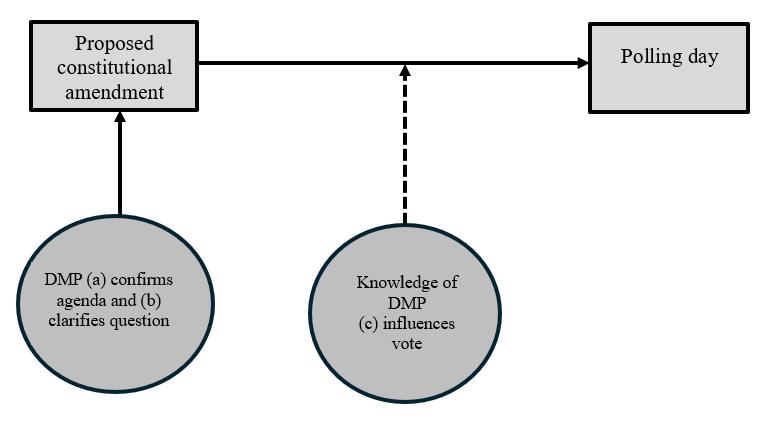
As noted, referendums have not featured that prominently in the Irish story to date: of the 22 referendums that were recommended by the six DMPs, six were called, of which three were successful. Nevertheless, most attention has tended to focus on the referendum outcomes, and especially the high profile constitutional amendments to legalise abortion and gay marriage. Undoubtedly, these were major reforms, and they demonstrated an important role for DMPs in the Irish referendum process, working in a partnership relationship with government (Figure 1), in which the DMP plays a “consensus clarifying role”, (a) helping the government in deciding whether to call the referendum and (b) in clarifying the referendum question.10 As indicated by the dotted line in Figure 1, the DMP can also indirectly (c) influence the referendum vote, playing “a significant role in the process of public will formation”.11 Survey-based research on the abortion and gay marriage referendum votes shows that those voters who had good objective knowledge of the DMPs that preceded the referendums were significantly more likely to vote “Yes”.12
But this partnership between government and DMP doesn’t always work as intended. The heavy defeat of two referendums held on the same day in early 2024, both of which had followed recommendations of the Citizens’ Assembly on Gender Equality, heralded a change of mood in political circles over the future of DMPs.13 All of a sudden, the role of DMPs in guiding the politicians’ hands on referendum proposals came into question. Then, later that same year a new coalition government was elected, again centred on the two centre-right parties, Fianna Fáil and Fine Gael, but this time including some independent parliamentarians as ministers who were also centre-right. There was no centre-left group anchoring this government, and thus no surprise when the government chose not to establish any new DMPs. Ireland’s deliberative tide had gone out—for now at any rate.
II. The potential of “deliberative referendums”
The lack of any new citizens’ assemblies provides an opportunity to reflect on other potential ways of deploying deliberative processes in the Irish context. In a recent paper, Hendriks and Wagenaar explore the benefits of “deliberative referendums”, where DMPs and referendums are linked in different ways (some of which we have reviewed above): they suggest that “the deliberative referendum seems an idea whose time has come”.14 This has a particular resonance in the Irish case, which is one of the most frequent users of referendums, ranked third in Europe after Switzerland and Italy.15 By no means does this frequency in use reflect a burning desire to keep calling referendums by successive governments; rather, it is a consequence of the need to hold referendums to change the Constitution, combined with unremitting pressures to amend the Constitution (e.g. due to the agenda of progressive social reforms, European Union treaty reforms, etc.).16
But the calling of a referendum comes with risks. In the first instance, there is the question of whether the public have sufficient information in advance of the referendum vote. A prominent debate in European elections research refers to the phenomenon of the public treating referendums as a lower priority than national elections, investing less time in them. According to this argument, referendums are seen as “second-order” elections: they are not viewed as having the same importance for voters as “first-order” elections, such as national parliamentary or presidential elections. This can result in lower levels of election turnout, and on occasions voters making use of their referendum vote to deliver a verdict on the performance of the government of the day, rather than to express an opinion on the issue being voted on.17 Evidence of second-order voting occurring in practice is mixed: it tends to be less pronounced where there is greater public awareness of the issue at hand.18 This is easy enough to envisage whenever the referendum question is about a hot topic such as abortion or gay marriage,19 but not all referendum questions are that “hot”, particularly when it comes to technical or complex issues, which can present governments with a dilemma over how to proceed with a constitutional reform that may well be of public significance, but not easy to sell to voters. And, arguably, this is becoming ever-more difficult in a time of increasing voter dis-engagement from representative politics.20
An additional factor that feeds into the process of voter dis-engagement is the growing phenomenon of disinformation and misinformation during election and referendum campaigns. In its global report on the year of elections in 2024, the Electoral Integrity Project found that over-half of the 74 elections it monitored saw instances of disinformation and misinformation during the election campaign, including prominent instances of hybrid attacks by foreign actors based in Russia, China and Iran that “undermined the credibility of political actors or the electoral process itself”. One of its key recommendations was that Election Management Bodies (EMBs, such as Electoral Commissions) should be “proactive in their communications and promote transparency throughout the electoral cycle. It is no longer enough for EMBs to perform to a high standard; they also need to be seen to be doing so.”21
Figure 2. Deliberative referendums II: DMP in a support role
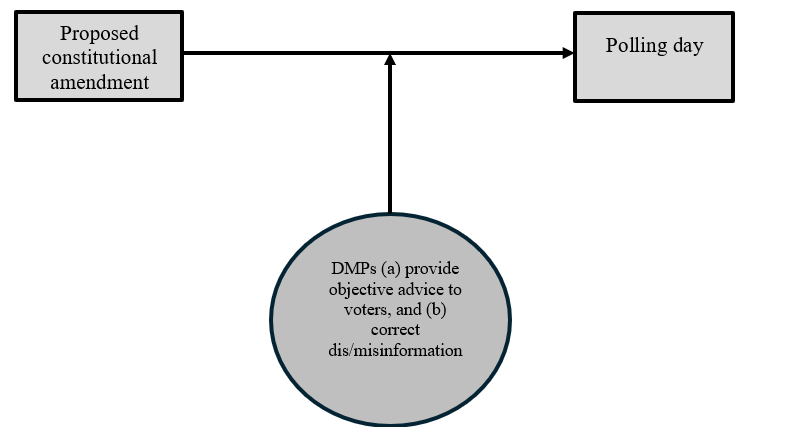
In this section, we consider how DMPs could play a new role in Irish referendums that addresses these two problems by (a) providing objective, citizen-led advice to voters about the issue they have been asked to vote on, and (b) harnessing citizen voices to provide timely responses to instances of disinformation or misinformation in the heat of a referendum campaign. As we saw above (Figure 1), Irish DMPs have tended to operate in a partnership role with the legacy institutions. It may have been in a somewhat subordinate position to the legacy institutions, but nevertheless, the DMP had input in determining the agenda of the referendum, and in that sense at least had some skin the game. What is proposed in this section is a new role for DMPs in supporting the Irish referendum process. In this instance, the DMP plays no part in determining the question to be put to voters. The vote is called by the government in the conventional way. The DMP is then established in a support capacity to ensure that voters receive accurate information about the issue that they are about to vote on.
As outlined in Figure 2, there are two potential tasks that a DMP could play that are worth considering, in both instances, working under the auspices of Ireland’s new Electoral Commission, which was established in early 2023 following recommendations of two DMPs.22 The Commission is a statutory, independent body, with responsibility over the main features of the Irish electoral process, including referendums, where its remit is to “prepare impartial and unbiased information about referendum proposals and make that information available to the public”.23 To that end, it produces an information booklet that is circulated to all voters in advance of polling day; it also publishes advertisements across all media platforms, and its spokespeople are regularly interviewed during the course of the campaign. In a national voter survey after the most recent referendums of 2024, 77 percent of respondents reported that they had received the Electoral Commission’s information booklet. Just under a third of the respondents (32 percent) found the booklet helpful or very helpful,24 suggesting that while the Commission is successful in its remit of providing information to voters, perhaps there is scope for improving the quality of that information.
One means of doing so would be to add an additional task to the Electoral Commission’s remit, requiring it to establish and provide administrative support for the work of a what we might call a Citizens’ Referendum Panel, a DMP comprising a small number (20-25) of participants who are randomly selected from the wider population. The proposal is that they are given four-to-five days to learn about and discuss the proposal that is to be voted on in the impending referendum, following the conventional practice in DMPs of hearing from experts and advocates and becoming informed on the matter. Their task would be to produce a one-page Citizens’ Statement, that sets out the details of the proposal to be voted on, and summarizes the key arguments in favour of and against the proposal. This one-pager should then be included in the Electoral Commission’s information booklet, and it should be made clear that it has been produced by fellow citizens in a deliberative process.
This proposal follows existing practice in a number of referendum contexts. Having originated in the US state of Oregon, where it referred to as a Citizens’ Initiative Review (CIR, reflecting the fact that referendums there can originate from citizens’ initiatives), the process has been trialled in other parts of the US, such as in Arizona, Colorado and Massachusetts,25 and most recently in parts of Switzerland.26 This form of DMP offers an interesting example of how it can provide important, carefully crafted information to aid the voters in making up their mind on which way to vote, thus “facilitating linkages from the micro-level agenda-setting stage to the macro-level referendum campaign”.27 There is consistent evidence (from the Oregon case and in other cases) of voters becoming more knowledgeable and informed as a result of reading the information supplied by the CIR.28 In their most recent assessment of the evidence, Gastil and his colleagues note that “the CIR model works as a means of improving public knowledge in advance of elections”.29 A survey experiment to coincide with a 2018 referendum in Ireland made just the same finding,30 providing good evidence of the potential of this process in the Irish context.
The use of regular citizens to support the work of the Electoral Commission should not end there. To help counteract the growing instances of disinformation and misinformation in recent Irish elections,31 an additional DMP could be tasked with providing a fast-track deliberative process ready to respond in a timely fashion to media broadcasts or articles where there are concerns over the veracity of the content. This is particularly urgent in the heat of a referendum campaign that occurs over just a few weeks, and especially so in the closing stages of the campaign. In order to facilitate a nimble and timely process, the proposal is to borrow from recent Belgian experience. In 2019, the tiny German-speaking region of Belgium established a permanently instituted citizens’ assembly process, known as the “Ostbelgien model”, whose role is to commission annual citizens’ assemblies tasked with feeding in proposals for policy reform to the parliament.32 A core feature of this process is that the body charged with establishing the citizens’ assemblies is made up of a selection of citizens (drawn by lot) who were involved in one of the previous citizens’ assemblies, the rationale being that their prior experience means that they are already familiar with how to operate in deliberative processes.
A similar logic could be deployed to establish a process designed to respond speedily to instances of disinformation and misinformation during Irish referendums, by recruiting a small panel (perhaps this might be called a Citizens’ Campaign Panel) comprising a subset of participants—perhaps five—from the Citizens’ Referendum Panel who had produced the one-page information sheet on the referendum proposal. Given their small number, their prior experience of being involved in deliberative processes, and their prior knowledge of the subject-matter of the referendum proposal, the Citizens’ Campaign Panel would be well-placed to quickly consult relevant experts and produce a timely response to support the work of the Electoral Commission in countering the attempt to distort the referendum campaign by spreading inaccurate information.
These proposed Citizens’ Referendum and Citizens’ Campaign Panels have the merit that they place citizens front and centre in the process of referendums, giving them a key role in providing objective and accurate information to the wider body of citizens and helping to counteract the malign efforts of bad actors seeking to spread false information. This is all the more important in a context in which referendums are becoming more common while their potential for success is becoming more challenging.
Re-imagining deliberative democracy in Ireland
One thing that is clear from the experience of deliberative democracy in Ireland to date is that Irish politicians in general hold a positive disposition towards DMPs, but this is combined with a reluctance to cede influence to them. The “partnership” model that operated over a busy decade from 2013-2023 may have had its day: at this point it is hard to tell. But the fact that deliberative democracy has had such a proven success in Ireland makes it all the more imperative that the experience should not be allowed to end there. That plus the fact that, like it or not, future Irish governments will need to call further referendums in a time in which referendum campaigns are becoming more challenging, means that thought should be given to new ways of engaging deliberative processes in a “support” role to ensure the provision of accurate information before and in the heat of a referendum campaign. This paper had suggested two options for re-imagining deliberative democracy in Ireland that merit consideration, perhaps allowing the country to retain its status as “the jewel in the crown of deliberative democracy”.


