The Norway and Marion Lutheran Congregations in Clayton County, Iowa commemorated their One-Hundredth Anniversary together in 1951. For this important occasion, they published a book dedicated “to the memory of the Pioneers and Pastors who braved the dangers and hardships of a new settlement west of the Mississippi and who made sacrifices to found Lutheran Churches for themselves and the generations to follow” (One-Hundredth Anniversary, 1851–1951. Norway-Marion Lutheran Congregations, Clayton County, Iowa). This book included photographs of church buildings, previous pastors, officers, and current organizations of the congregations. Its centerpiece was a narrative history by un‑named authors who hoped it would “point to the part we have played in building America and the Norwegian Lutheran Church in America”.1 This rather typical history began by naming the first Norwegian “settlers” to the area as well as noting the reasons for the immigration itself. Next, the history noted when the settlers held their first religious services. It continued to chronicle the subsequent building projects and pastors.
Figure 1. – Dedication page and first image in the commemoration anniversary book of the Norway-Marion Lutheran Churches.
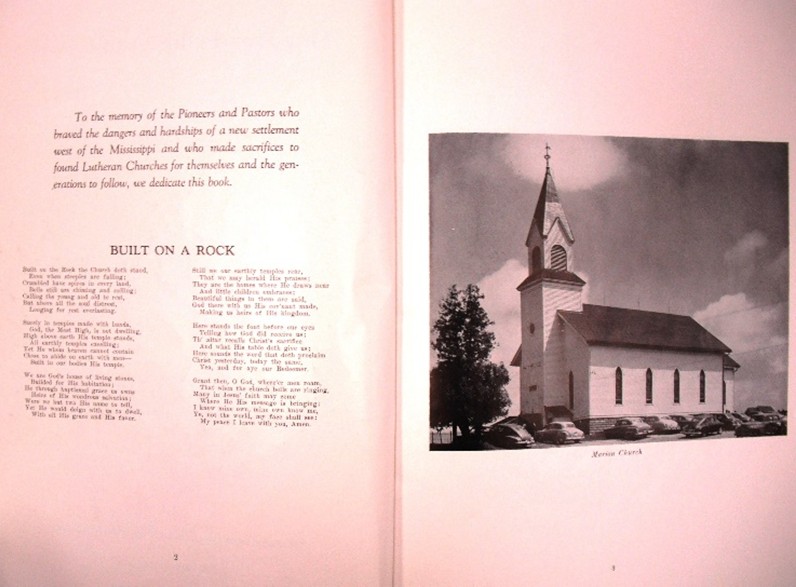
“One-Hundredth Anniversary, 1851–1951”, Norway-Marion Lutheran Congregations, Clayton County, Iowa (1951).
Congregational commemorations at the time of a significant anniversary reveal much about how rural Midwesterners understood immigration, themselves, and their place in America after World War II. Congregations usually published a book with a narrative history and photographs. The selection of past events and people in these histories revealed what people found meaningful in the past and valued in the present. These sources allow the historian to listen-in as the people made sense of their past for the present (Schultz; Øverland; Pederson 128–133). The present generation was encouraged to overcome their own struggles by reading about immigrants who succeeded by overcoming hardships. These selective histories showed that rural Midwesterners saw themselves as good Americans who had descended from hard working, faithful immigrants.
These rural congregations stood at the heart of the social and cultural patterns in the nineteenth century as well as for those who remained members after World War II (Swierenga 1997; Barlow and Cantonwine; Madison; Neitz; Ammerman 1994; Ammerman 2005). One of the reasons for the importance of the congregations was the number of European immigrants who settled in the rural Midwest in the nineteenth century. They started churches very soon after arriving in a new location creating a “heavily churched landscape” (Ostergren 1981, 225). As the number of European immigrants flowed into the Midwest in the late nineteenth and early twentieth century, they created a “cultural homeland” (Hoelscher and Ostergren 88). As historians have shown for the past forty years, migrants chose to move to particular communities and these immigrant communities were typically formed around congregations and denominations (Gjerde 1985; Gjerde 2002; Kamphoefner; Ostergren 1988; Coburn; Swieringa 2000).
Understanding how rural Midwesterners remembered their past provides insights into views of immigration and borders after World War II. They drew borders around who was a good American and who was a good immigrant. They repeated what Paul Spickard has called an “Ellis Island” paradigm. This paradigm stressed a story of assimilation for European immigrants but overlooks the effect on Native Americans or restrictions on immigration from other areas (Spickard 6–28). Spickard mainly focuses on political and intellectual leaders who articulated this paradigm. However, this paradigm was not only top down but also came from the bottom up. Many rural Midwesterners believed that their ancestors in the second half of the nineteenth century defined the paradigm for what made America great as they assimilated into America easily. Studying how these people on the ground thought about America and the place of immigration helps tell the story of this era and better explains the rural Midwest.
Since the people of the rural Midwest saw themselves as quintessential Americans, their definition of themselves shaped larger narratives. Rural Midwesterners have variously been labeled as either heartland people or flyover people. For rural Midwesterners, these have historically been connected and troubling. Being heartland people meant that they represented the very heart of the American experience. On the other hand, if the Midwest was labeled flyover country, this meant the country was flying over its heart (Lauck; Higbie 81–90; Kiel). Seeing themselves as heartland people, including having immigrant roots, meant that the Ellis Island paradigm shaped how they saw immigration and who was a worthy American after World War II. Iowa examples are used in this study because it is an exemplar state in the Midwest (Schwieder; Madison).
Much historical scholarship about the era after World War II emphasizes that people with immigrant roots no longer had an immigrant or ethnic identity (Conzen et al.; Sollors; Gans). Historians have explained this fading ethnic identity after World War II for a variety of reasons. Immigration from Europe had slowed since the 1920s so fewer Europeans relied on ethnic institutions in their daily lives as they adjusted to life in the United States (Bukowczyk; Luconi). Other historians argue that ethnic loyalty decreased as racial identity increased. For much scholarship on white ethnicity, the 1950s and early 1960s represent a time when other identities took precedent over particular European ethnicities (Gerber; Jacobson 1998; Kolchin; Guglielmo; Roediger; Bayor). Finally, some look at the “generations” of the immigrants and note the changes to the second generation. This literature generally argues that European immigrant roots only mattered during the subsequent “roots” movement of the 1960s and 1970s (Jacobson 2006). At the same time, literature about the place of immigrants in the United States in the twentieth century often focuses just on political discourse about immigration (Ngai; Daniels; Pruitt). This literature focuses on the rhetoric of spokespeople and politicians as well as particular laws showing that immigrants did not always receive a warm welcome. The restrictions on immigration were mostly pushed by those who wanted the United States to be populated by whites, Anglo-Saxon Protestants (Higham; King). Many of the rural Midwesterners would fit this category but little is written examining their attitudes about their own immigration or the immigration of others. As efforts to reform immigration restrictions gathered strength, these people continued to remember their immigrant ancestors as excellent examples of successful immigrants. In many ways, they thought all immigrants could enjoy the same kind of success their ancestors had and failed to notice the structural impediments for subsequent immigrants.
The people living in the rural Midwest after World War II constructed their ideas about themselves and their immigrant ancestors in a very specific context. They faced both real and perceived upheavals that transformed their world. Their churches seemed to experience the possibilities of increased resources but feared peril that might lurk around the corner. Demographics changed as rural areas lost political power to urban areas. Rural schools struggled to maintain their standing in communities as school consolidation swept the area. Agriculture changed to emphasize higher and higher production using chemicals and mechanical technology (Wuthnow 1988; Danbom; Anderson 2009; Wuthnow 2011; Anderson 2014). The context of the changes in the rural Midwest points to the desire to look for a stable and usable past. As the world changed around them, they actively constructed a story about their immigrant ancestors that focused on their ancestors’ role in building America as they overcame hardship. Their immigrant ancestors had built institutions that had brought stability to rural life. Telling stories about immigrants who had been through the upheaval of immigration but had built stable lives gave comfort to those experiencing upheaval.
True Americans
As rural Midwesterners with immigrant roots told stories about their past, they defined themselves and their ancestors as true Americans. They thought of themselves and their immigrant ancestors as those who had made the land productive through hard word. This notion that American history had been a history of taking the land and cultivating it could be traced back to the original colonists. While not explicitly connecting themselves to the Pilgrims or Puritans, the idea that it was natural for Europeans to control the land in North America framed the overall narrative of how rural Midwesterners thought about their pioneering ancestors. Of course, this construction meant that urban immigrants or non-Europeans did not fit the definition of being true Americans.
Writers of commemorative histories emphasized how these immigrants had started cultivating the land as farming pioneers. In these narratives, the land required human intervention to be productive. Histories noted how good the land was and how early pioneers had found cheap and fertile land. The Norway-Marion Lutheran Church in Clayton County, Iowa remembered how the first settlers had chosen to start in the hills and woodlands before they realized “the value of the vast expanse now known as the ‘Garnaville Prairie’” (One-Hundredth Anniversary, 1851–1951. Norway-Marion Lutheran Congregations). The Springfield, Iowa Lutheran Church’s history noted that the pioneers “endured hardships as they cleared the land, broke the sod, carved out from the wilderness home for themselves” (One Hundredth Anniversary: 1853–1953. Springfield Lutheran Church, Springfield, Iowa). The writers of the Glenwood, Iowa Lutheran Church history also highlighted the “cheap and fertile land” the “brave men and women” found in Northeast Iowa (One Hundredth Anniversary: 1853–1953, Glenwood Lutheran Congregation, Winneshiek and Allamakee Counties, Iowa). One church history even went so far to point out that the first settlers were “sons and daughters of the soil. They wrestled with the sod that had laid untouched through the centuries of time” (75th Anniversary: 1885–1960, First Reformed Church, Hull, Iowa). The history of the Big Canoe Lutheran Church in 1953 noted that “the pioneers who settled here experienced the same struggles and hardships as other settlers who came from Norway in those days to carve out homes for themselves” (One Hundredth Anniversary: 1853–1953, Big Canoe Lutheran Church, Big Canoe, Iowa). The work of being pioneers portrayed these immigrants as true Americans.
Figure 2. – Cover image of the commemorative anniversary book of Glenwood Lutheran Congregation.
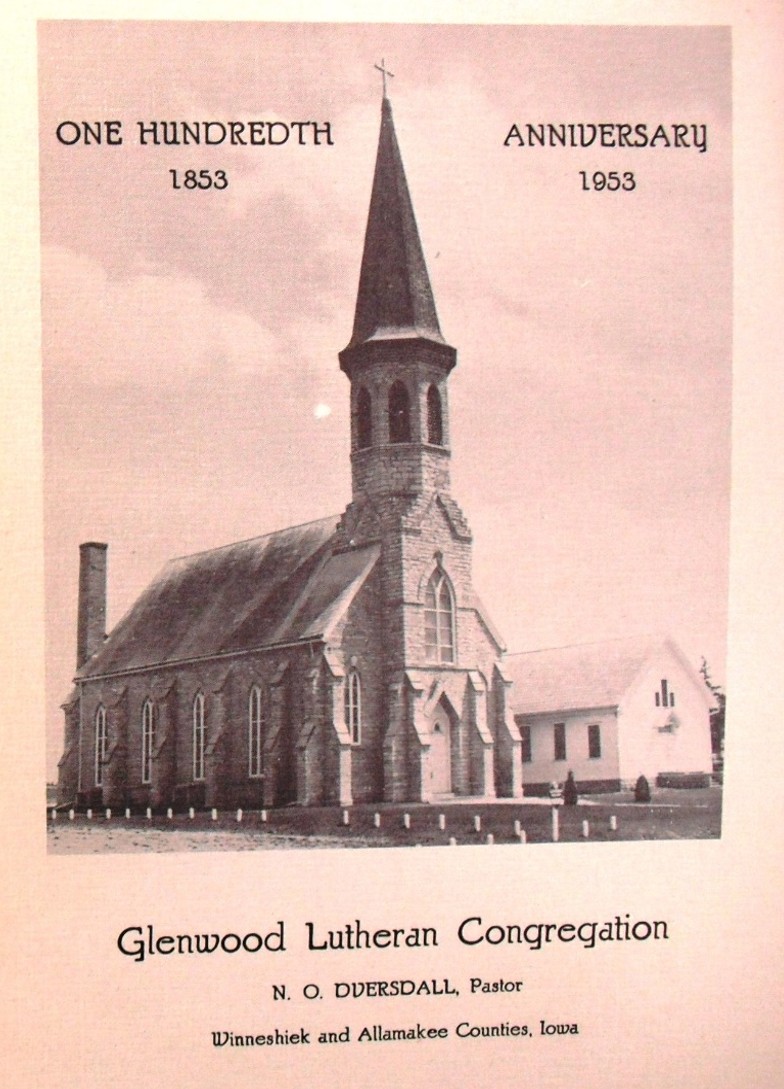
“One Hundredth Anniversary: 1853–1953”, Glenwood Lutheran Congregation, Winneshiek and Allamakee Counties, Iowa (1953).
These histories emphasized the hardship and danger that greeted these immigrant pioneers. As the history of the St. John’s Lutheran Church in Madrid, Iowa detailed “no one can realize the hardships endured and the sacrifices made by these early settlers. Wild Indians roamed about in search of plunder” (100th Anniversary, St. John’s Lutheran Church, Madrid, Iowa). Another history pointed out the dangers of pioneer life including a list of dangerous animals and “sometimes the Indians added interest and excitement to the routine of the day” (History: 1875–1950, St. John’s Lutheran Church, Adair, Iowa). The Native Americans were seen as a danger and nuisance and not as people who also had claim to the land. The dangers also included, according to Immanuel Lutheran Church in Clarinda, Iowa’s history “prairie fires and bitter cold on the windswept plain” (100 Years: 1869–1969. Immanuel Lutheran Church, Clarinda, Iowa). The danger of fire prompted the history writers of the Immanuel Lutheran Church in Spirit Lake to note that matches were necessary during travel in order to “start a back‑fire in case of prairie fires, which were then not uncommon” (Diamond Jubilee: 1878–1953, Immanuel Lutheran Church, Spirit Lake, Iowa). These stories imagined the American heartland as a dangerous land that these immigrants had tamed as true Americans.
Histories that highlighted the hard work and dangers that came with making the land suitable for farming not only reflected what they understood to be the meaning of being a true American, but also the anxiety about the ways farming changed after World War II. This nostalgia for their immigrant ancestors as pioneers on the land suggested a desire for a pastoral, pre‑industrial era of farming during a time of technological changes. Writing about their ancestors, the writer of the Immanuel Lutheran Church in Clarinda, Iowa’s history noted that “farm technology, conservation techniques, marketing, education, medical services, transportation, and means of communication have changed drastically since the days of pioneers, but it is debatable whether or not people are happier now than they were in the pioneer days of our community” (100 Years: 1869–1969. Immanuel Lutheran Church, Clarinda, Iowa). This nostalgic view of earlier times shaped how rural Midwesterners framed the history. As the 1961 history of the Calamus, Iowa Our Savior’s Evangelical Lutheran history put it “these early pioneers ventured with no small amount of bravery to a new land” (One Hundredth Anniversary: 1861–1961, Our Savior’s Evangelical Lutheran Church, Calamus, Iowa). Another history writer noted that “Brave hearts and strong arms were their chief assets” (100 Years: 1861–1961. Estherville Lutheran, Church. Estherville, Iowa). They also came with a determination and a desire to succeed. The history of the East Clermont Lutheran Church of Clermont, Iowa in 1951 noted that early pioneers had “come from Norway with a determination to make this their adopted country and to build for themselves a home they could call their own […] Many were almost penniless when they arrived” (Centennial Anniversary: 1851–1951, East Clermont Lutheran Church, Clermont, Iowa). In a time of changes, the nostalgic view of self‑made immigrant farmers who, through hard work and bravery, contributed to America framed these histories.
America also was a place of freedom in these histories. In the way these congregations told their history, freedom and opportunity defined America. As the Swede Valley Lutheran Church of Ogden, Iowa, noted “pioneers […] saw their dreams take on reality” (Because of Christ: 1868–1968. Swede Valley Lutheran Church, Ogden, Iowa). Forest City, Iowa’s Immanuel Lutheran explained how Scandinavian immigrants were “coming to a land of liberty and opportunity”. One pastor even went so far as to acknowledge that success as a congregation at least partly came from the government granting freedom of worship and assembly (50th Anniversary: 1908–1959, First Christian Reformed Church, Ireton, Iowa). America was the place where immigrants came to build a life because of freedom and opportunity.
Freedom also meant being able to use their foreign language. Histories noted the long use of homeland languages even as all these congregations used English by the 1950s and 1960s. In telling their story about themselves, the transition to English usually seemed simple. The St. John’s Lutheran Church in Alta, Iowa waited all the way until 1934 when “it was found necessary to conduct both German and English services every Sunday” (Diamond Jubilee: 1880–1955, St. John’s Lutheran Church, Alta, Iowa). This passive explanation makes it seem that the transition was simple and easy even if over fifty years had passed since the founding of the congregation. The congregational histories usually retold how the congregation had voted to slowly change one or more services to English. In other histories, the first mention of using English was when the congregation began keeping records in English (Celebrating Our 100th Anniversary: 1870–1970, St. Olaf Lutheran, Church Bode, Iowa; Seventy-Fifth Anniversary: 1877–1952, Deer Creek Evangelical Lutheran Church, Carpenter, Iowa). None of the histories noted how it had been multiple generations before the language had changed to English. This slow transition in using English reflected how they saw non‑English speaking as part of the American experience. These commemorators seemed to not have cared that their multiple languages spread across the heartland.
However, many churches recounted the negative sentiments towards foreign language use during World War I. The Zion Evangelical Lutheran Church in Atlantic, Iowa noted that “public sentiment was against those who used the German language” during World War I (75th Anniversary, Zion Evangelical Lutheran Church, Atlantic, Iowa). In fact, the language issue during World War I prompted the Humboldt, Iowa Zion Lutheran congregation to petition the authorities to continue using German in services (Eightieth Anniversary: 1884–1964, Zion Lutheran Church, Humboldt, Iowa). The Schleswig, Iowa Immanuel Lutheran Church in 1962 explained what happened during World War I as “people from other communities came here and insulted our people, spoke of their lack of patriotism, though we bought as many liberty bonds as anyone and our sons also marched away to war” (1912–1962, Immanuel Lutheran, Church, Schleswig, Iowa). Restrictions on using foreign language for services affected how rural Midwesterners thought about being immigrants. For instance, the Peoria, Iowa Christian Reformed Church, fifty years after the events, remember how “feeling ran high between those who had advanced more rapidly in the process of Americanization and our Holland people who were continually coming from the fatherland to settle in America” (Seventy-Fifth Anniversary: 1894–1969, Peoria Christian Reformed Church, Peoria, Iowa). St. Olaf Lutheran Church of Belmond, Iowa called laws during World War I requiring English-only services as a “frenzy of misguided patriotism”. Yet, this history went on to note that the “unusual edict undoubtedly hastened the change from Norwegian services to English as more and more were clamoring for services in the language their children and young people could understand” (75th Anniversary: 1888–1963, St. Olaf Lutheran Church, Belmond, Iowa). World War I was an anomaly as they enjoyed the freedom to use a foreign language.
Commemorating immigrant ancestors, then, actually made these rural Midwesterners true Americans. Immigrants, whether from Norway, Sweden, Germany, or the Netherlands, had benefited from policies, social structures, and cultural beliefs about what made a good immigrant and a true American. Rural Midwesterners after World War II overlooked historical factors when thinking about what made a good immigrant. They simply transferred an “Ellis Island” paradigm to all immigrants and ideas about what made a good immigrant. Being good immigrants and true Americans, in the way rural Midwesterners constructed these categories in their commemorations, was not possible for many immigrants.
Institution builders
Rural Midwesterners also emphasized how their immigrant ancestors had not only built farms, but also churches and other institutions. The overall chronology of the narrative histories usually followed the building projects of the church. These congregations clearly valued their “little white church” and the work required to build and maintain it. These commemorations reinforced the important role the church and other institutions played for those sitting in the pews after World War II. According to these histories, their immigrant forbearers were institution builders. These histories were meant to inspire loyalty to the institutions as churches faced upheavals. The physical church buildings were presented as tangible manifestations of successful, hard-working immigrants. The histories generally told the story of the first meetings held in homes or some other community structure. More often than not, the first meeting took place in a school. Other first-meeting places might include the town hall or even another congregation’s building. When they could gather enough money, they built a simple structure on purchased or donated land. The congregations often needed to replace these first structures as success meant a need for more space. In fact, one congregation boasted that their second building “was as large as any other in Ogden with a capacity of 400 people” (50th Anniversary: 1914–1964, Immanuel Lutheran Church, Ogden, Iowa). Even if these early wooden structures succumbed to fire, which seemed to happen regularly, the congregation saw the rebuilding as another way to demonstrate their commitment. Pictures of these various structures graphically showed the commemorators after World War II the importance of the buildings.
The images on the cover of the Immanuel Lutheran Church in Clarinda, Iowa in 1969 made this striking framework the cover to their anniversary book (100 Years: 1869–-1969. Immanuel Lutheran Church, Clarinda, Iowa). The sense of achievement for these rural Midwesterners in building their buildings is clear through the way they told their stories.
Figure 3. – Cover image of the Immanuel Lutheran Church of Clarinda, Iowa showing institution success through the various buildings depicted.
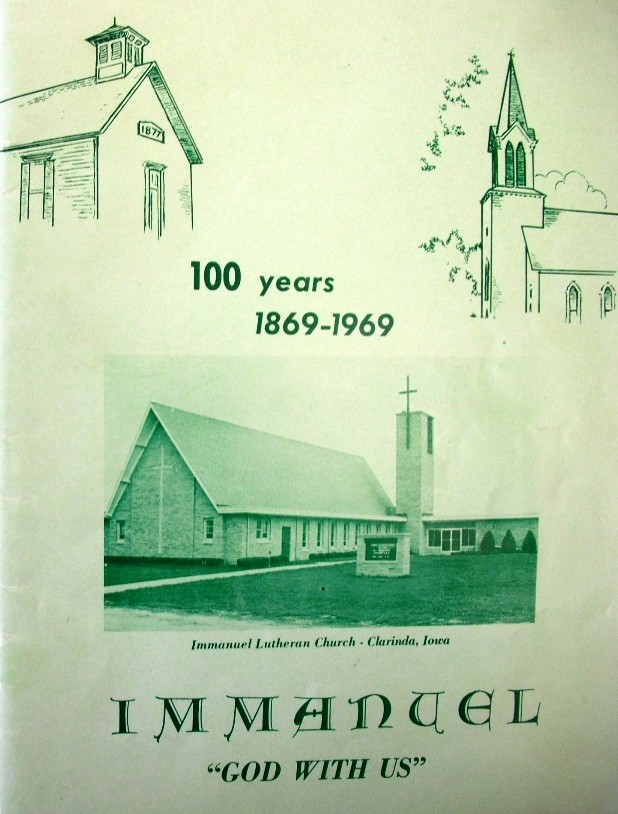
“100 Years: 1869–1969”, Immanuel Lutheran Church, Clarinda, Iowa.
The histories of these congregations explained how the building projects required hard work and sacrifice. The East Clermont Lutheran Church of Clermont, Iowa noted, “Many of the people here assumed heavy burdens and many great sacrifices were made for the work of the church” (Centennial Anniversary: 1851–1951, East Clermont Lutheran Church, Clermont, Iowa). The sacrifices made for the purpose of the institution gave the current generation role models. A pastor’s message in the Hull, Iowa’s First Reformed anniversary book in 1960 noted that “without the sacrifice, the willingness, the determination and the undaunted faith of pioneering fathers and mothers the history of this Church could not be read as it does” (75th Anniversary: 1885–1960, First Reformed Church, Hull, Iowa). The history of the St. Paul Evangelical Lutheran Church in Boone, Iowa, noted that “members of the congregation were poor and many of them in strained circumstances, so that it took a great deal of faith and trust in God to undertake the building of a new church edifice” in 1898 (A Century of Progress, St. Paul Evangelical Lutheran Church, Boone, Iowa).
The success of the congregation was often attributed not just to hard work and sacrifice, but to the shared life of the members. These building projects were accomplished partly through the way the community helped each other. One church’s history noted how “the settlers were willing to lend things, and to help one another”. In fact, the story went, “these pioneers carried on uncomplainingly amidst privation, discomfort, and difficulties. […] God blessed their efforts, and in due time a measure of prosperity and well-being came to most of them” (One Hundredth Anniversary: 1853–1953, Big Canoe Lutheran Church, Big Canoe, Iowa). The Calmar Lutheran Church also remembered how their buildings required help from others after a lightning strike burned the church in 1887. The history remarked that “this shows the spirit of the pioneers to help one another when help was needed” (One Hundredth Anniversary: 1853–1953, Calmar Lutheran Church, Calmar, Iowa). Commemorative histories celebrated the corporatism of the early immigrant pioneers (Gerdje 2002, 8‑21).
Building institutions, both physically and socially, could extend to broader institutions as well. They did not just build their own local church, but united in shared denominations and larger institutions. These post‑war rural Midwesterners with an immigrant background emphasized how their forbearers connected with other immigrant enclaves in these efforts. These communal institutions such as academies and colleges often received mention in congregational commemorations. For instance, the St. Olaf Lutheran Church of Bode, Iowa mentioned the Bode Academy that started in 1887 (Celebrating Our 100th Anniversary: 1870–1970, St. Olaf Lutheran, Church Bode, Iowa). Many noted the specific synod that the church belonged to over the years. The disputes in the Norwegian Lutheran churches in the 1880s over theology often received a mention in the history of these churches. These seemed to end happily, though, when three Norwegian groups came together to form the Norwegian Lutheran Church in America in 1917 (75th Anniversary: 1888–1963, St. Olaf Lutheran Church, Belmond, Iowa). If there were changes in synod affiliation or name, the history writers duly noted the change. This particularly affected churches who belonged to synods that combined with other synods. A church in Calumet, Iowa felt this acutely when it recounted changing its name from German Zion’s Evangelical Church to Zion Evangelical and Reformed Church to Zion United Church of Christ in the span of just over thirty years (75th Anniversary: 1892–1967, Zion United Church of Christ, Calumet, Iowa). For many German Lutherans in the Missouri Synod, committing to the denomination meant that they were part of a faithful, orthodox Lutheran denomination, according to the histories (Anniversary Booklet: 1878–1963, St. John Evangelical Lutheran Church, Germantown, Iowa; History: 1875–1950, St. John’s Lutheran Church, Adair, Iowa). The major division between Dutch immigrants in the Reformed Church in America and the Christian Reformed Church could be felt in histories that recounted the split from either side (Swierenga and Bruins). The denominational connection mattered, particularly as they showed the work of joining with others in common cause.
History writers also highlighted denominational and institutional connections by noting where pastors came from and where they went. Pastors played almost as important of a role in framing the congregational narrative as the building projects. According to the histories, early settlers eagerly welcomed pastors’ visits. When the congregation finally had enough resources to pay a regular pastor, they felt they had finally succeeded. Pastors meant regular sermons as well as administration of the sacraments. With such an important role in the life of the congregation, the specifics of each pastor’s coming and going provided the periodization for many congregational histories. Tracing the geography of where pastors came from and where they went highlighted the connections to other congregations in the denomination and enclaves of other immigrants. The Lutheran Church-Missouri Synod commemorations specifically highlighted the locations of the pastors, linking these German immigrants together to build a mental map of their denomination (for just one example, see 75th Anniversary, Zion Evangelical Lutheran Church, Atlantic, Iowa). Dutch congregations probably had as strong of a geographic sense as any group (for just one example, see 50th Anniversary: 1908–1959, First Christian Reformed Church, Ireton, Iowa). The commemorative histories highlighted where pastors had come from and where they went providing another connection to the denominational efforts of the congregation.
Of course, these broader connections could be tricky to negotiate as denominational affiliations changed. Telling the history of denominational splits and mergers required some sensitivity as issues could still be raw after World War II. For instance, the splits within the Norwegian synods in the 1880s and merger in 1917 needed to be handled carefully. The Norwegian Lutheran congregation in Decorah, Iowa split in the 1880s. The congregations downplayed the theological dispute in their 1963 histories as they were both part of the same denomination after 1917. The Decorah Lutheran Church noted that “opinions concerning this Doctrine differed and divisions occurred in many places” (Centennial: 1863–1963, Decorah Lutheran Church, Decorah, Iowa; One Hundredth Anniversary: 1863–1963, First Lutheran Church, Decorah, Iowa).
Figure 4. – Inside page of the Silver Lake Lutheran Church commemorative anniversary book depicting both the rural nature of the church as well as the portraits of pastors.
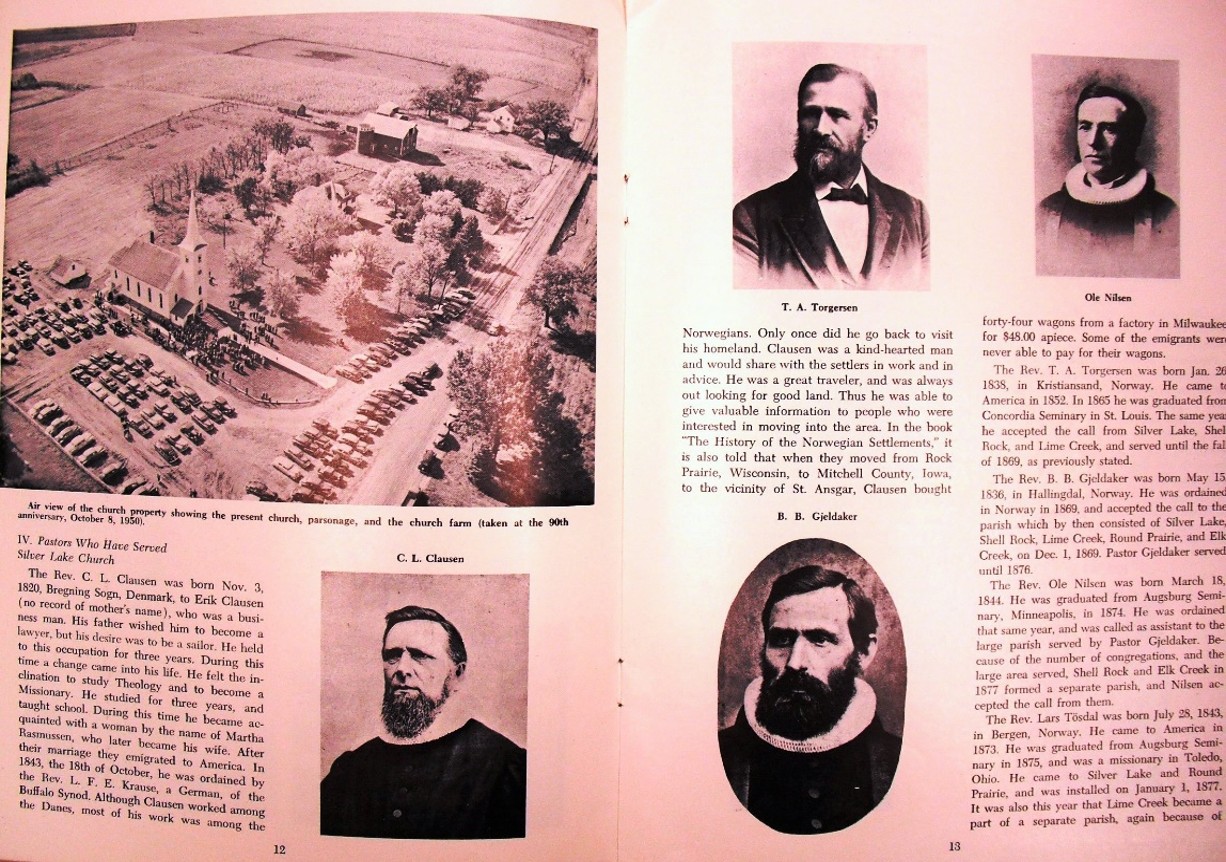
“Centennial: 1858–1958”, Silver Lake Lutheran Church, Silver Lake, Iowa.
Constructing church buildings and connecting with other congregations in denominations provided the outline for congregational histories. These outlines reflected the importance of the institution building by immigrants and subsequent generations. They had worked hard and sacrificed for these institutions and the post‑World War II generation was expected to continue them even in the face of changes. Telling the history of institutions, started by immigrants, showed that immigrants could build institutions through hard work and sacrifice.
Faithful
According to the history told by rural Midwesterners after World War II, the institutions were built and maintained by the immigrants and their descendants because of their faith. In an era of congregational changes, those in the pews remembered their immigrant ancestors as being faithful. Dedication to immigrant forbearers who had a strong faith proliferated. The commitment to their faith could not be doubted as they had immigrated and built their lives and institutions in a new place. The Buena Vista County, Iowa St. John’s United Church of Christ dedicated the commemoration “to those of yesterday, our forebearers [sic] who desired that their worship and service to God may be continued in this new land to which they had come” (Seventy-Fifth Anniversary: 1888–1963, St. John’s United Church of Christ, Buena Vista County). The Meriden, Iowa Oakdale Evangelical Free Church in 1967 dedicated their efforts to the “highly esteemed pioneers of our church whose labor of love and zeal for Christ merit our gratitude” (Behold the Works of the Lord: 1892–1967, Oakdale Evangelical Free Church, Meriden, Iowa). Another congregation dedicated theirs “to the pioneers who down through the years bravely applied their faith as they built […] a Christian community” (75th Anniversary: 1880–1955, Immanuel Lutheran Church, Forest City, Iowa). These dedications defined the purpose for remembering the history.
The rural Midwesterners told their history to emphasize the role faith played in the lives of their ancestors. Histories of these congregations often emphasized the regular Bible reading and worship services attendance of these early pioneers. One congregation’s history even explained how “they kept holy days as well as Sunday” which the writer proudly related had “confused their neighbors” (100th Anniversary, St. John’s Lutheran Church, Madrid, Iowa). Another history noted how “the family altar was never omitted in their homes and church holidays were religiously observed” (Centennial Anniversary: 1859–1959, Stratford Evangelical Lutheran Church, Stratford, Iowa). Calmar Lutheran Church in 1953 noted that “As the church in their homeland had been the central point around which the main events in their lives centered […] the lack of it here in their newfound home was keenly felt” until they could build a congregation (One Hundredth Anniversary: 1853–1953, Calmar Lutheran Church, Calmar, Iowa).
Being faithful also meant sacrifice. For people living after World War II in the rural Midwest, the sacrifices of their ancestors for the cause of the local congregation and denomination showed the kind of dedication that inspired continued sacrifice. The writer of the First Reformed Church in Boyden, Iowa in 1963 noted that “we are amazed at the accomplishments of that small group […] Their prayers, sacrifices and hard work” helped build a strong church (Diamond Jubilee: 1888–1963, First Reformed Church, Boyden, Iowa). As another history noted “We reap the harvest of their sacrifices in both the material and spiritual realms”. The same congregational history noted that to build a bigger church, the congregation had a “willingness to sacrifice for the Kingdom of God” (One Hundredth Anniversary: 1853–1953, Glenwood Lutheran Congregation, Winneshiek and Allamakee Counties, Iowa). The faithful sacrifices of the past served as a model for the present congregation.
The history writers continually emphasized how the congregation had remained faithful to a particular theology. German Lutherans who formed the Lutheran Church-Missouri Synod were particularly ardent in noting the loyalty of immigrants to the cause of orthodox Lutheranism. The language used in these books is revealing as they often noted how immigrants had been faithful to “our faith”. Remaining faithful to this particular theology became the overt argument of the writers of the history of Zion Evangelical Lutheran Church in Atlantic, Iowa in 1952 who wrote “in a generation when changing creeds are popular, Zion still seeks to hold and confess the Word of God in its truth and purity and to administer the Sacraments accordingly” (75th Anniversary, Zion Evangelical Lutheran Church, Atlantic, Iowa). Dutch congregations also noted the particular Calvinistic theology their forbearers had specified. For instance, the First Reformed Church of Hull, Iowa in 1960 noted that “early settlers, religious people of Calvinistic extraction” had started the congregation (75th Anniversary: 1885–1960, First Reformed Church, Hull, Iowa). Remembering the importance of particular theology mattered to congregations in a time of church mergers and ecumenical initiatives. The St. Olaf Lutheran Church of Bode, Iowa noted that “one of the many typical traits of a Norwegian-American was his intense loyalty to the Lutheran church” (Celebrating Our 100th Anniversary: 1870–1970, St. Olaf Lutheran, Church Bode, Iowa).
Recounting the faithfulness of the members in the past was meant to encourage the current generation. The histories placed forbears as examples to be followed. Big Canoe Lutheran’s history called the current congregation to “be worthy successors of the founding fathers” (One Hundredth Anniversary: 1853–1953, Big Canoe Lutheran Church, Big Canoe, Iowa). St. Paul’s Evangelical Lutheran made clear in the introduction “We shall aim to carry on the work of a past generation so that the results of our efforts shall be a more abundant blessing for the generations to follow” (Seventy-Fifth Anniversary: 1894–1969, St. Pauls’ Evangelical Lutheran Church, Garner, Iowa). The dedication of the Germantown, Iowa’s St. John Evangelical Lutheran Church’s commemoration in 1963 hoped “it encourages this and future generations” (Anniversary Booklet: 1878–1963, St. John Evangelical Lutheran Church, Germantown, Iowa). St. John’s United Church of Christ in Buena Vista County, Iowa laid out their purpose for the history to be a “reminder of the faith of our fathers, which, amidst the trying time of early pioneer days founded our church and loyally supported it […] we wish on this anniversary to look forward with courage and faith to a yet more fruitful future” (Seventy-Fifth Anniversary: 1888–1963, St. John’s United Church of Christ, Buena Vista County). As one history noted, the readers “owe a debt of gratitude to those who have gone before us” and can “most adequately pay that debt by being diligent in our Christian living” (Dedication Album, Our Savior’s Evangelical Lutheran Church, Albert City, Iowa). The sentiment came through clearly in a rousing call of the Big Canoe Lutheran Church in 1953, “Then shall we be worthy successors of the founding fathers” (One Hundredth Anniversary: 1853–1953, Big Canoe Lutheran Church, Big Canoe, Iowa).
Conclusion
Understanding the historical process of remembering immigration via commemorations of rural Midwesterners in a time of upheaval seems particularly pertinent to understanding the rural Midwest, and journalists have been particularly interested in the rural Midwest political culture since November 2016. Commemorations told narratives that “cleaned‑up” their immigrant past to meet the needs of the new situation they encountered. These stories left certain parts of history untold. None placed women as central characters. A few mentioned the role of women, usually when the Ladies’ Aid Society started, but women did not have a starring role in the stories. These stories also did not place the process of taking the land in the broader context of American history. Additionally, strife or conflict within the United States, let alone racial and ethnic borders that crossed the Midwest, also did not make the cut for the histories either.
At the same time, the writers of these histories did recognize the selective nature of the narrative. For instance, the Stratford, Iowa Evangelical Lutheran Church history noted they had included “only the most interesting highlight in the growth of the congregation” (Centennial Anniversary: 1859–1959, Stratford Evangelical Lutheran Church, Stratford, Iowa). The St. Olaf Lutheran Church of Bode, Iowa’s history in 1970 noted “there are no doubt some inaccuracies and omissions because of limited data or a complete lack of records” (Celebrating Our 100th Anniversary: 1870–1970, St. Olaf Lutheran, Church Bode, Iowa). These selective immigrant stories provide a vision of America centered on an immigrant story of settlement and development while overlooking aspects of conquest and exclusion.
Of course, there were other rural Midwesterners in congregations who did not tell stories about immigrant ancestors. These churches did tell stories, but instead of focusing on immigrants, they focused on the pioneers who started the church. While not connecting their church to immigration from Europe, their histories followed much of the same framework. These Methodists, Presbyterians, and Baptist stories also had less “exclusive” language of “us” and “our” that is found in the immigrant church commemorations. This juxtaposition points to the value of immigration stories in this era. For those churches who could claim an immigrant heritage, they marshalled it for their own purposes.
These stories then show us how people in the rural Midwest constructed a story that placed themselves, and their immigrant ancestors, in the heart of the national story: a national story of good immigrants making the land, building institutions, and having a strong faith. As the world changed around them, these stories would serve their purpose in trying to maintain their way of life and central place in the United States story. These made‑in-the-heartland stories then fed into national narratives that others used for political and cultural purposes. The implicit purpose of telling the history of the church often bubbled to the surface in these church commemorations. The past was being used to place these former immigrant congregations within the borders of the mainstream of the American story.
Studying closely the stories of rural Midwest Protestant ethnic churches conceptually forces us to recognize the importance of representations of immigration beyond simple stereotypes. Immigration for the people in these churches had receded into the past. Nostalgia and heritage trumped the reality of immigration and settlement. This study demonstrates how representations of immigration served people who lived in the heartland and found them helpful to make their way in the world (Lenz; Cramer; Hochschild). As the church served at the heart of the community’s identity and social world, then how they saw themselves in their time and place gives us insights into cultural border construction. Churches played a role in helping people think through the changes they experienced. This meaning-making function can be glimpsed in church commemorations as people told stories about themselves for themselves (Butler). Only by looking at how people remembered immigration, on the ground, for the people who lived out their immigrant identity, do we get a fuller, richer story of the American experience.