
Introduction
In 1878, Ngāti Kahungunu politician and writer Henare Tomoana published a highly critical essay in the Māori-language newspaper Te Wananga concerning European colonial land acquisition. The article, referencing settler-colonial efforts to alienate land from its Indigenous stewards, argued that “to unravel a Maori title requires a knowledge of so vast an amount of the old history of the race, that it excludes any European from being able to sit as a Maori claim to land.”1 Tomoana’s words were a clear expression of resistance against imperialist expansion in Aotearoa New Zealand, symbolic of wider anti-colonial tendencies within Māori literature. Invoking whakapapa (ancestry) in explaining the inseparability of the land and its people, Tomoana aimed to combat prevailing European ideas of land resource possession from a Māori standpoint. In doing so, he contributed to a regional literary tradition of resistance against imperialistic resource exploitation.
The south-eastern districts of Te Ika-a-Māui, Tomoana’s home, had for decades been the subject of what Cameron Boyle labels “the settler-colonial project of mass migration.”2 From 1841 onward, European colonists settled and occupied Wairarapa, a remote district within this area. Wairarapa constitutes a series of valleys separated from Wellington by mountain ranges, and was at the time dominated by “belts of forest”3 variegating fertile alluvial land, providing Māori with resources for subsistence horticulture. This land was the tūrangawaewae (ancestral home) of numerous hapū (autonomous clan-groups), including Ngāti Moe, Te Hika a Pāpāuma, and Ngāti Hamua, among others. To the Indigenous Ngāti Kahungunu and Rangitāne iwi (tribal groups) of the region, settler-colonialism imposed upon the socioeconomic stability afforded by traditional cultivation of the whenua (land). In further modifying these environments, settlers threatened the traditional attachments of Māori to the resources that formed the foundation of their culture.
While Māori had effected their own changes to the land in centuries prior, Europeans viewed these alterations as insignificant and incompatible with settler capitalism. Environmental historian Anna Boswell characterizes this “continuing crusade”4 of imperialism as part of a wider “ecocide”5 enacted by European colonists. Here, “scorched-earth colonial policies”6 contributed to imperialist efforts toward eradicating Māori connections to their land. As analyst Kate Riddell explains, settler-colonists aimed to minimize the significance of this ecocide through cultural supplantation: as “the land was cleared and ‘improved’ by European toil […] the native was supplanted by the introduced.”7
Against the backdrop of these prevailing ideologies, settlers also characterized Māori as passive observers of this ecocide of land alienation rather than resisting it. However, the surviving corpus of Māori-language primary literature refutes such allegations. This paper contends that, during Wairarapa’s early colonization from 1841 to 1853, Māori consistently asserted mana whenua (sovereignty over land) in their literary expressions of resistance. In examining three types of oral and written works, this paper explores the varying techniques by which Māori would engage with colonial land resource exploitation. First, Māori-language press publications on land alienation are analyzed, contextualizing such disruption within the Indigenous sociopolitical milieu. Second, this article investigates the role of personal letters in constructing environmentalist opposition. Finally, this paper scrutinizes the missionary corpus of recorded oral testimony by Wairarapa anti-colonial activists. It is argued that these assertions of mana whenua center the agency of Wairarapa Māori in defying colonial encroachments on their tūrangawaewae.
Figure 1. Map of Wairarapa, created c. 1860 by unknown colonist
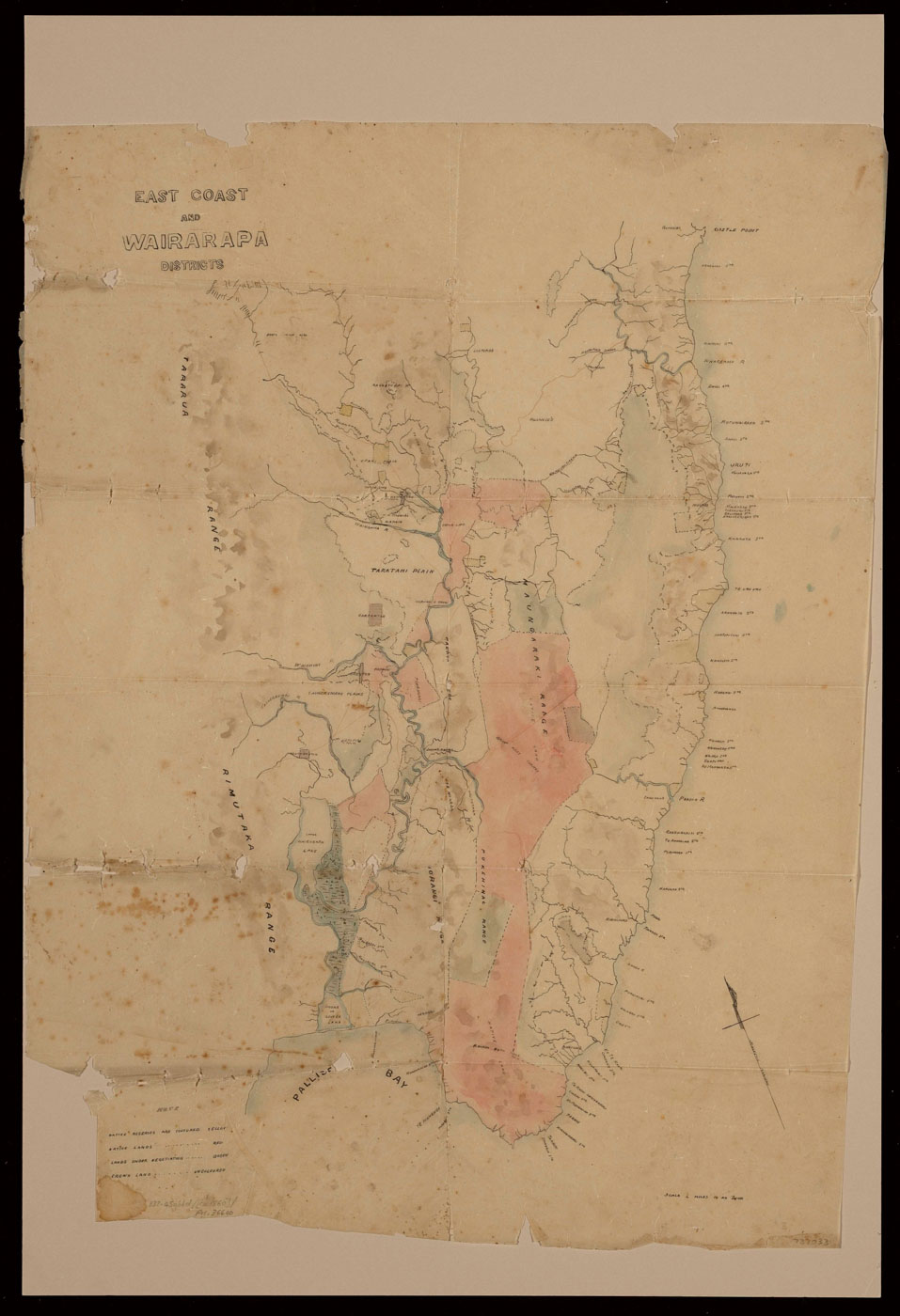
Grassland, mountains, swamps, and forest are noted on the map. Pink shaded areas represent land under Māori ownership by this time.
Repository: Alexander Turnbull Library, Wellington, New Zealand, reference number: MapColl-832.45gbbd/[ca.1860]/Acc.36640
Courtesy of the Alexander Turnbull Library
Historiography and Methodology
Until fairly recently, relevant historiography was dominated by what Kerry Howe describes as an “overarching paradigm of Māori as victims”8 in the face of colonial ecocide. In general, previous scholarship has reinforced colonial narratives of passivity in the region, presenting Māori as mostly indifferent to European expansion into local environments. Environmental historian Paul Star emphasizes that prior research characterized European attitudes toward Aotearoa’s natural environments in a relative vacuum, “cut without awareness of […] the indigenous environment.”9 Michael Roche’s History of Forestry (1990), for instance, portrayed Māori as prioritizing environmental conservation, but not necessarily actively opposing ecocide.10 In public histories such as Rebecca O’Brien and Robert McClean’s Environmental Issues Overview Report for the Tararua District (2001), Māori are described as “struggling people”11 almost helpless against the “systematic destruction of taonga and cultural rights.”12
Significant work has been done within historiography toward rectifying these issues, especially by Māori themselves. A now-substantial bibliography exists in characterizing the overall body of early environmentalist works produced by Māori. These sources, in general, have examined Māori responses to land alienation and their consequences during the time period in question, emphasizing their agency and retention of mana (spiritual prestige) in creating anti-colonial texts.
Eva Rask Knudsen’s foundational The Circle and the Spiral (2004) establishes a critical postcolonial framework for analyzing anti-ecocidal Māori literature, especially relevant to investigations from an “outside-in perspective”13 such as this paper. Knudsen notes that the writers of anti-colonial literature tended to separate themselves from settler viewpoints, opposing ecological threats through concepts grounded in Māori tradition. These writings, Knudsen argues, functioned as socially functional objects and promoted “the perseverance of Indigenous spirituality and tradition”14 in the literary construction of Māori anti-ecocidal arguments. Knudsen emphasizes the role of wāhine (women) in this literature, contrasted with the patriarchal “Pakeha environment.”15 Similarly, in Vincent O’Malley’s The Meeting Place (2012), it is argued that women played a major role in recognizing and resisting ecocide, representing part “of the wider community”16 that would “adjudicate upon […] daily living”17 equally to men. Wāhine contributed regularly to komiti (council) discussions, in deliberate contrast to European patriarchy.
Paola Della Valle, in From Silence to Voice (2010), reaches similar conclusions informed by this postcolonial view, commenting that “a site of Maori resistance – a chink in the armor of colonial authority – originated in the production of texts.”18 Literature aided in preserving the memory of significant locations, including those rich in resources important for mahinga kai (traditional food-gathering practices). Della Valle also notes that Māori subverted settler-colonists’ “dominant discourse”19 in literature, producing “cracks within”20 colonial knowledge systems. O’Malley argues that this opposition was based on the “far from […] trivial infringements”21 of colonists in violating tuku whenua (the traditional systems underpinning communal land transference) with “the aim to restore balance”22 motivating this rejection.
Other authors typify Māori literary responses to ecocide in terms of their own experiences, an Indigenous-led collection of views that are privileged throughout this investigation. Works framed around collective resistance, for instance, have been examined as forms of anti-ecocidal rhetoric. As Danny Keenan (Te Āti Awa) writes in Environmental Histories of New Zealand (2002), “Māori expressed their responses to vanishing landscapes in many different forums […] [They] perceived the totality of environmental change and sought to relate to it.”23 Frith Te Aroha Driver-Burgess’s 2015 thesis “Korero Pukapuka, Talking Books” also describes popular literature among Māori as part of a pattern of “cohesive action.”24
It is important to consider the place that written and recorded texts held within Māori cultural conceptions of the world during this early period of colonization. Arini Loader’s (Ngāti Raukawa, Ngāti Whakaue, and Te Whānau-a-Apanui) chapter in A History of New Zealand Literature (2016) described, similarly, how Māori considered written material on environmental policy politically. In the circulation of these works, narratives coalesced around Māori cosmological connections to the land, especially referencing whakapapa as part of this historical record. Literary resistance, including that which was spoken, centered on “demonstrating and reinforcing”25 such relations to the land. Keenan, likewise, expresses that “Māori sought to control the meanings”26 of their experiences through “assertions of identity and mana,”27 calling upon “specific historic landscapes”28 in formulating resistance. Nēpia Mahuika (Ngāti Porou), in Rethinking Oral History and Tradition (2019), notes that political literature on ecocide could be contextualized within “the same whaikorero (speechmaking) conventions of the marae.”29 Loader has also noted that wāhine were heavily involved in literary processes, defining whakapapa relationships through their creative work.30
Collectively, these sources provide a strong framework for the analysis of Māori anti-colonial texts and their opposition to the early European ecocide in Wairarapa. Evidently, literature, including speech, occupied a significant place in Māori societies throughout the period. In the dissemination of literature, tangata whenua (Indigenous people) displayed a strong sense of agency against European-led environmental disruption.
Niupepa (Newspapers)
Coinciding with the first European incursions into Wairarapa was the colony-wide establishment of a number of niupepa (newspapers published either fully or partially in the Māori language). This constituted a major change in the methods by which Māori could communicate with each other.31 The public dissemination of the written word allowed for the transmission of ideas beyond the marae (meeting place), promoting wide-scale political discussions.
Initially, niupepa were often used as an instrument by which the Crown (colonial government) attempted to mitigate attitudes of resistance among Māori, both in Wairarapa and beyond. Niupepa such as Te Karere o Niu Tireni aimed, according to contemporary English settler Thomas Hocken, “to explain the beneficent laws of civilization,”32 with a view to subsume Māori cultures under European rule. No Māori served on or with the editorial board of Te Karere o Niu Tireni, administrated by English-born Chief Protector of the Māori, George Clarke.33 Clarke’s main interest in publishing the paper, according to Hocken, was to promote “the cultivation of land”:34 that is, forest clearance. An article of 1842, for instance, appropriated the perspective of an anonymous Māori correspondent in arguing for land clearance: “me tango i tenei ritenga rangatira mo koutou.”35 These positions continued to define Crown niupepa as organs of colonial propaganda throughout this period of imperialist expansion.
The publication of independent niupepa, however, somewhat countered these propagandistic attempts at persuading Māori toward passivity regarding land alienation. Among these niupepa was the Southern Cross, published in Auckland by Scottish settler John Logan Campbell, a critic of then-Governor George Grey’s regime of land acquisition, which he described as benefiting only “speculators, fly-by-night land jobbers, and adventurers.”36 Moreover, he was outwardly sympathetic to local Māori. As such, the Southern Cross was unusual in that it offered a generally pro-Māori viewpoint that published written statements opposing Crown policies and asserting mana whenua.
In 1849, the Southern Cross published a notice from a number of rangatira (hapū leaders) criticizing the methods by which land was acquired, discussing how tuku whenua (traditional land transference) was subverted during Crown land sales throughout Wairarapa. At this time, Governor Grey and Land Purchase Commissioner Donald McLean aimed to acquire the district’s “valuable” land, which ultimately occurred in 1853.37 Among these rangatira were Wiremu Kingi Wairarapa (Te Āti Awa) and Ernest Porutu (Ngāti Hamua), residents of Wairarapa who were known for hardline stances on land resource exploitation.38 Citing proposed Wairarapa land sales, the notice argued against laws allowing for the alienation of Māori-held whenua:
kihai matou i whakaae ki a te Kawana te mana o to matou Motu me tuku ano ki nga pakeha na tau tikanga i rawa kore ai matou. Kua rongo nei matou ko nga tangata o Wairarapa e tuku ana i a ratou kainga ki nga pakeha [...] na te Kuini i mea mana ano matou e ti aki me o matou taonga ho mai ra te ritenga o nga tangata o te Kuini.39
The letter illustrates a literary current among Wairarapa Māori wherein niupepa created “a sense of community engagement,”40 as Driver-Burgess explains, using the newly introduced medium of print to argue against colonial land exploitation. The contents of niupepa were generally read aloud to groups, reinforcing political discourse as a communal, literary activity.41 Niupepa contributors were aware of this custom and often addressed it directly. For instance, an anonymous contributor alluded: “as Sir George Grey read […] to the Natives, so I hope all white men that live near the pahs at Wellington, at Wairarapa […] will read mine to them also.”42 In recognizing collaborative Māori reading practices, these contributions became effective counter-propaganda against land alienation and, consequently, ecocide. Niupepa quickly became cemented within Māori literature as a method by which concerted opposition to land seizure could be widely distributed among iwi, hapū, and whānau (families).43
While the writings featured in niupepa such as the Southern Cross were deeply connected to Māori literary traditions emphasizing the whakapapa of whānau and their ties to the land, many writers chose to use techniques unconventional to the medium. The integration of these complex techniques often subverted conventions of Māori information systems as a whole. According to Hemopereki Simon, traditional forms of Māori literature such as mōteatea (chants) and waiata (songs), often created by wāhine, typically used hapū-specific idioms opaque to outsiders.44 In creating literature intended for wider consumption, writers extended what Knudsen describes as “symbolic meditation”45 outward into the wider Māori “political unconscious”46 throughout the colony by reducing their use of such idioms in the interests of accessibility.
Authors of niupepa correspondence occasionally acknowledged this functionality. In a letter of 1843, for instance, prominent Te Āti Awa statesmen and Wairarapa landholders Wī Tako Ngātata and Te Ropiha Moturoa wrote to the hapū of Cook Strait about Land Commissioner William Spain’s effective nullification of their iwi’s land claims, stating “ama uake nei kiakite tatou i te he otira kaua e wakanuia te korero ki te ngutu o te tangata otira ki a mohio nga tangata katoa, o nga kainga katoa o nga Maori. Heoi ano a matou korero.”47 The letter, published in the New Zealand Colonist, urged the Māori inhabitants of coastal kāinga (settlements) to acknowledge colonial transgressions. While also encouraging them to refrain from direct violent resistance, it reinforced to hapū that concern surrounding environmental preservation existed outside of their local communities.
Notably, the letter contains few allusions specific to Te Āti Awa while retaining poetic techniques familiar to a wider Māori audience. Structural references to waiata and mōteatea appear in the correspondence, exemplified by “short, quick, self-evident phrases”48 of the type identified by Loader and Jane McRae as a feature of waiata tangi (mourning songs) and whakaaraara pā (sentry chants), signaling the seriousness of the authors’ intentions in expressing their “complaints.”49 Its framing as an open letter, incorporation of poetic techniques, and secondary translation into English indicate that Wī Tako and Moturoa desired for readers to internalize this ecocide across gender and ethnic boundaries, retaining a deliberately broad audience.50
Pukapuka (Private Letters)
By 1841, letter writing had become a common form of literary production in Māori societies throughout the archipelago. Pukapuka (in this context, direct correspondence) had, since at least the first decade of the 19th century, gained an important status among Māori. As pieces of anti-colonial literature untethered from the intent of public display, unlike in niupepa, direct correspondence allowed Māori writers to establish, as Knudsen notes, their “own centers and foundations in [their] narratives,”51 deeply entwined with traditional knowledge systems.
These sources must be evaluated in context. Many incoming letters penned by Māori were destroyed or altered by the receiving administrators if, as Loader comments, the correspondence did “not paint [them] in a good light.”52 A notable exception was the collection of Land Purchase Commissioner Donald McLean, a Scottish colonist who spearheaded mass land alienation in Wairarapa from 1848 onward. According to historian Jim McAloon, McLean’s intent was “inculcating the moral economy of capitalism”53 and “imposing state control”54 upon Wairarapa Māori. Such convictions likely contributed to McLean’s diligent preservation of inbound correspondence, which could serve as evidence in later European-led legal cases involving land seizure.55 As such, the collection is especially relevant to this investigation.
Expressions from McLean’s collection reinforce that Māori employed traditional knowledge systems in opposing land seizure. Maintaining connections to whakapapa was one aspect of this resistance, entirely separated from the land’s financial value. For instance, the Ngāti Kahungunu inhabitants of Ahiaruhe, a kāinga on the plains of southern Wairarapa, retained decades-old ties to the whenua that entirely overruled land sale negotiations. The landholders clarified to McLean in a collective letter, scribed by Koroniria Rangataiki of Ngāti Porou:
tenei ano taku tikanga, ko nga kari e kore e tukua atu, kore rawa, kore rawa, kore rawa atu. Koi puta atu te tangata homai koe i au moni, inahoki he tokomaha nga tangata nona taua kainga. […] Ina hoki he wahi iti hoki tenei wahi e puritia nei e matou, ina hoki he uri ano toku; e kore e pai kia rere ki runga ki te puhi o te rakau noho ai. Heoi ano.56
Clearly, the maintenance of this ancestral tūrangawaewae superseded all other factors. Merely months prior, British surveyor Charles Pelichet had expressed to McLean that the land was “generally poor, barren, and very broken.”57 In a spiritual sense, then, the fertility of the land did not affect its heritage; McLean received similar letters from the forested northern settlement of Te Kāuru.58 Evidently, the continued observation of such traditions amounted to anti-colonial resistance by the residents of the land.59
Wāhine also engaged in anti-ecocidal resistance through letters. As Mahuika has commented, wāhine rangatira (female hapū leaders) occupied a unique position in defying colonial authorities, combining “a collective tribal sense of self-determination”60 with a heightened awareness regarding the “creeping colonial patriarchy.”61 The letters of Hine-i-paketia of Ngāti Kahungunu provide highly illustrative examples of these gendered responses to ecocide. Among the Indigenous custodians of Te Taperenui-a-Whātonga, a vast and heavily forested region in North Wairarapa, McLean described Hine-i-paketia as the “Principal person of the whole District.”62 After negotiations, McLean received a letter containing Hine-i-paketia’s demands, accompanied by a short message: “Koi riri mai koe ki tenei korero. […] Kia wawe te tae mai. Ka mutu naku.”63
Hine-i-paketia, through the “quick, self-evident phrases”64 of her letters, “sheltered”65 her whenua, as anthropologist Lyndsay Head has commented, exuding “the mana of chiefs.”66 In doing so, Hine-i-paketia effectively rejected European ideas of patriarchy, proving that “she was well able to attend to her own affairs,”67 including that of land administration and the recognition of whakapapa. Such a subversion of colonial expectations also existed in her reluctance to sell the land, perhaps also motivated by a defiance of European gender roles. Paola Della Valle has noted that Māori “women have always been […] given a special social function”68 in the preservation of whakapapa. A self-proclaimed Queen, Hine-i-paketia was clearly familiar with this role as it applied to her.69 In subverting colonial gender roles while reinforcing mana whenua, Hine-i-paketia’s letters serve as a rich example of Māori women’s collective resistance to the seizure of Indigenous-held environments.
Kōrero (Speech)
The spoken word constituted a major part of Māori society. Oral history was a microcosm of what Mahuika terms “the collision of fundamental political ideas […] related to the communal and inclusive self-determining of inter-tribal genealogies,”70 and constituted “the continuation of living tradition.”71 Written recounts were often noted in missionary journals during what Warbrick terms “a process of engagement”72 informed largely by British ideas of colonial supremacy. “This subjection of Māori oral history to tradition and Western modes of analysis”73 has led to inaccuracies in the portrayal of overall “native understandings of oral history,”74 Mahuika argues, filtering these kōrero through a distinctly colonial lens. Indeed, this filter between speech and recording limits the utility of oral testimonies recorded in this manner. Nonetheless, these texts illustrate the significant role that orality played throughout the period. Overwhelmingly, these surviving oral statements portray a cultural environment of anti-ecocidal resistance.
A prominent angle of recorded oral anti-ecocidal resistance would constitute anti-Christian dissent, especially regarding missionaries. As McAloon has argued, missionaries “regarded agriculture as the catalyst of Christianity and civilization”75 and integrated “botanical change”76 into the “religious and moral instruction”77 of Māori. These threats to the “coherence of Māori culture”78 did not stand unopposed, as Head argues. Many observers resisted what they perceived as a religiously motivated inequality in distributing ecological resources.79 An integral aspect of environmental management, the equitable redistribution of “valued resources”80 remained a priority for Wairarapa Māori, oppositional to Christian doctrine.
Head notes that missionaries were often perceived by rural Māori “as agents of the state [who] challenged traditional ideas about the value of land as strongly as Christianity challenged Māori morality,”81 emphasizing the intertwined perceptions of religious indoctrination and land resource exploitation. As such, rhetoric warning missionaries of resistance extended this defense of mātauranga Māori. For instance, Kawepō also encouraged tangata whenua to openly mock “the sagacity of the white man”82 in the presence of missionaries as a method of discouraging local colonial settlement. One rangatira warned missionary William Colenso: “e mea ana oti koe, tera e tu tau Hahi? Nana, akuanei, akuanei, maku ka hora ai nga Hahi o Heretaunga. Maku tenei wenua ka uhi ai ki te taonga.”83 Te Wereta (Ngāti Hinewaka) summarized this attitude to Colenso in 1845, writing “be thine the praying to God – be mine the praying to the Devil.”84 The cultural appropriation of environments was consistently linked to a collective resistance against their destruction.
Conclusion
Through niupepa, pukapuka, and kōrero, Wairarapa Māori would express their agency and conviction in resisting the environmental alienation perpetuated by European settler-colonists from 1843 to 1853. The authors of these literary works drew on fundamental aspects of Māori culture in constructing their rhetoric. The incorporation of traditional compositional methods, subverting European colonial ideals, would aid in their wider distribution. Niupepa, in widely dispersing works collectively opposing ecocide, and pukapuka, through their direct expression of discontent, became powerful methods by which imperialist expansion was defied and resisted throughout the district. Recorded kōrero also played a decisive role in asserting Māori ecological self-determination, preserving arguments against environmental destruction as they were expressed to colonists and among tangata whenua. Overall, these literary productions constituted sources of anti-ecocidal knowledge throughout this early colonial period, representing a strong undercurrent of resistance and defiance among Wairarapa Māori concerning the conservation of mana whenua.